Keukenhof is remarkable, but it’s also consistently one of the most visited attractions in the Netherlands and requires advance ticket booking, early arrival and crowd management.
The working fields that produce the bulbs sold worldwide sit just outside Keukenhof’s gates, publicly accessible and largely unvisited by international tourists. Here’s how to find them.
Keukenhof vs the Open Fields: A Real Comparison
| Factor | Keukenhof | Open Bollenstreek Fields |
|---|---|---|
| Cost | Paid, pre-book required | Free, visible from public roads and paths |
| Crowds | Very high in peak season | Low to moderate — mostly cyclists and local traffic |
| What you see | Curated garden, all colours, perfect displays | Working fields: long stripes of single colours, harvest machinery, raw agricultural scale |
| Best for | Photography in controlled setting, families | Cycling through landscape, experiencing tulips at agricultural scale |
| Timing flexibility | 9 AM–7:30 PM, timed entry | Any time, any day during bloom |
Where the Fields Are
The Bollenstreek — literally “bulb region” — runs between Leiden in the south and Haarlem in the north, centred on the villages of Lisse, Hillegom, Sassenheim, Noordwijk, and Voorhout. Keukenhof sits inside this same area (near Lisse), but the commercial growing fields that give the region its character extend far beyond the garden’s gates.
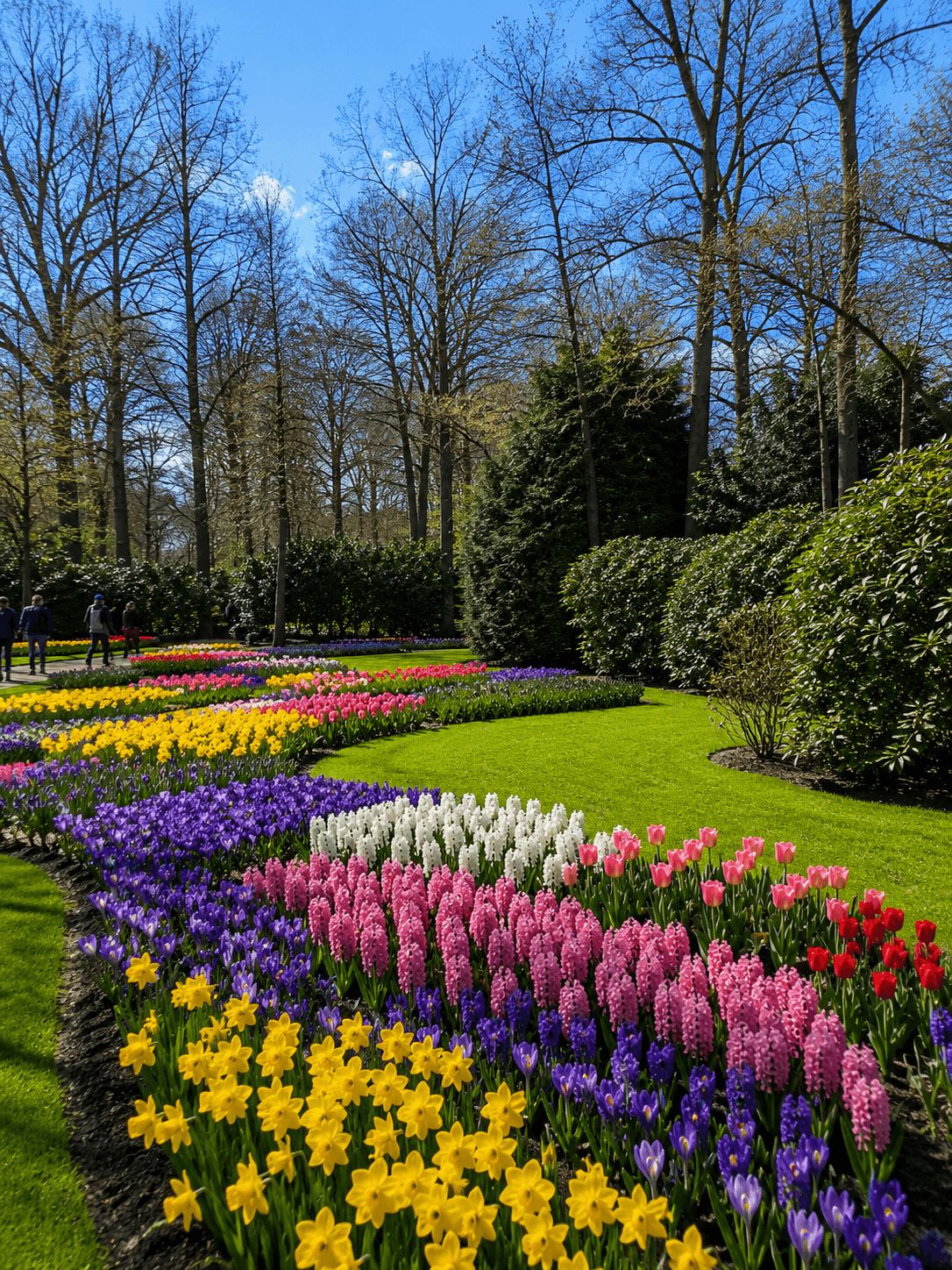
The curving flowerbeds that give Keukenhof its layered colour.
Best Cycling Routes Through the Fields
Several signed cycling routes traverse the Bollenstreek specifically during tulip season. among the most popular is the Bollenstreek Route — a roughly 30-kilometre loop connecting the main flower-growing villages that can be cycled from Leiden or Haarlem station in a single day. Following this route in mid-April on a clear morning gives you the striped field panoramas that appear in standard tulip-season imagery without the paid-entry structure of Keukenhof.
Starting Points
- Leiden station — trains from Amsterdam Centraal in 35 minutes; bike rental available
- Haarlem station — trains from Amsterdam Centraal in 17 minutes; the Bollenstreek route is signposted from the station area
- Lisse — accessible by bus from Haarlem or Leiden; the village is the route’s natural centrepoint
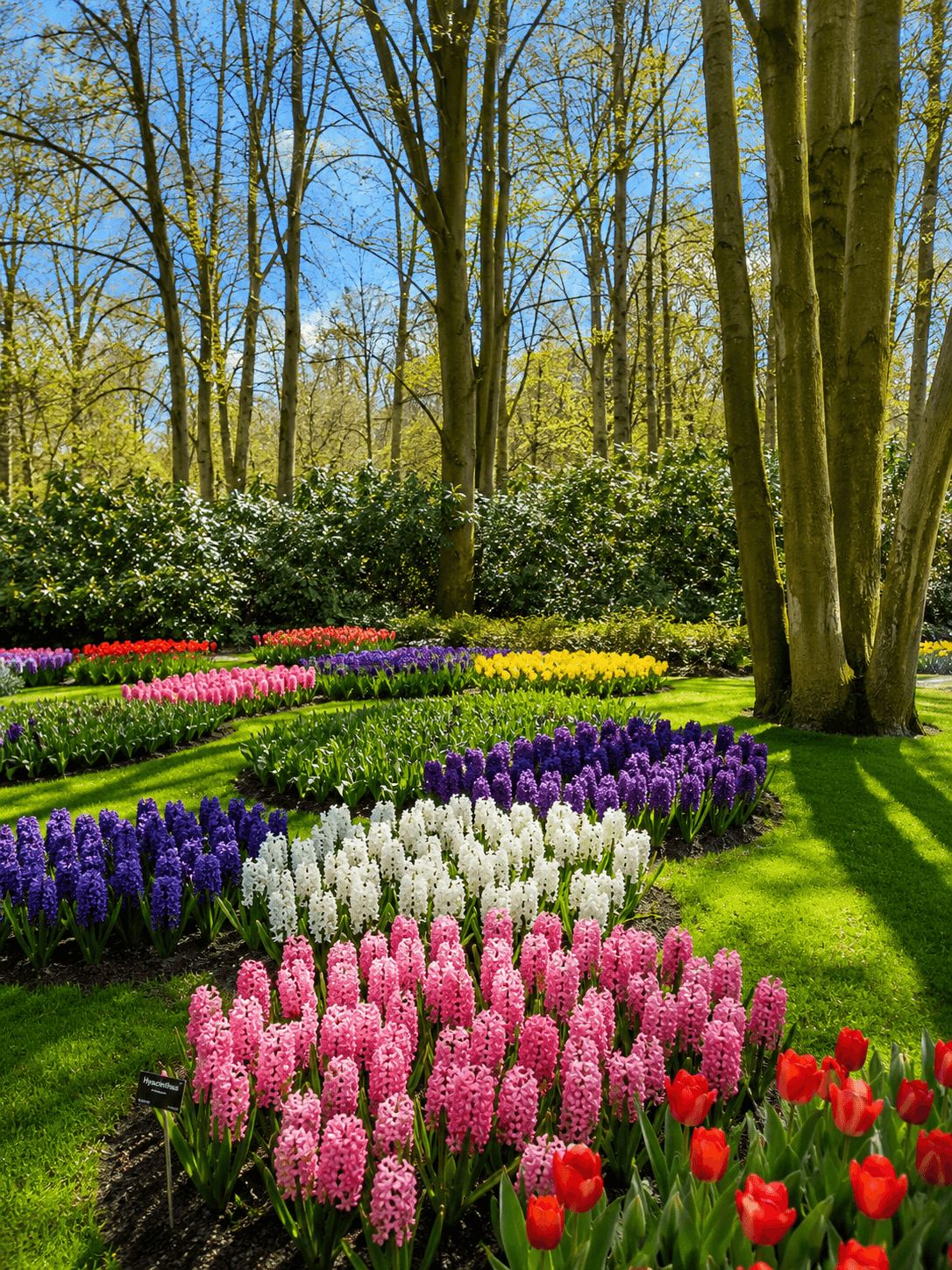
Hyacinths in full bloom, one of Keukenhof’s most fragrant displays.
Timing: What Week to Go
Peak bloom typically falls in the second and third weeks of April, though this shifts by one to two weeks in either direction depending on that year’s winter and spring temperatures. In a warm spring, peak can arrive in early April; a cold spring can push it into late April. The official Bollenstreek website tracks bloom progress and publishes updates during the season.
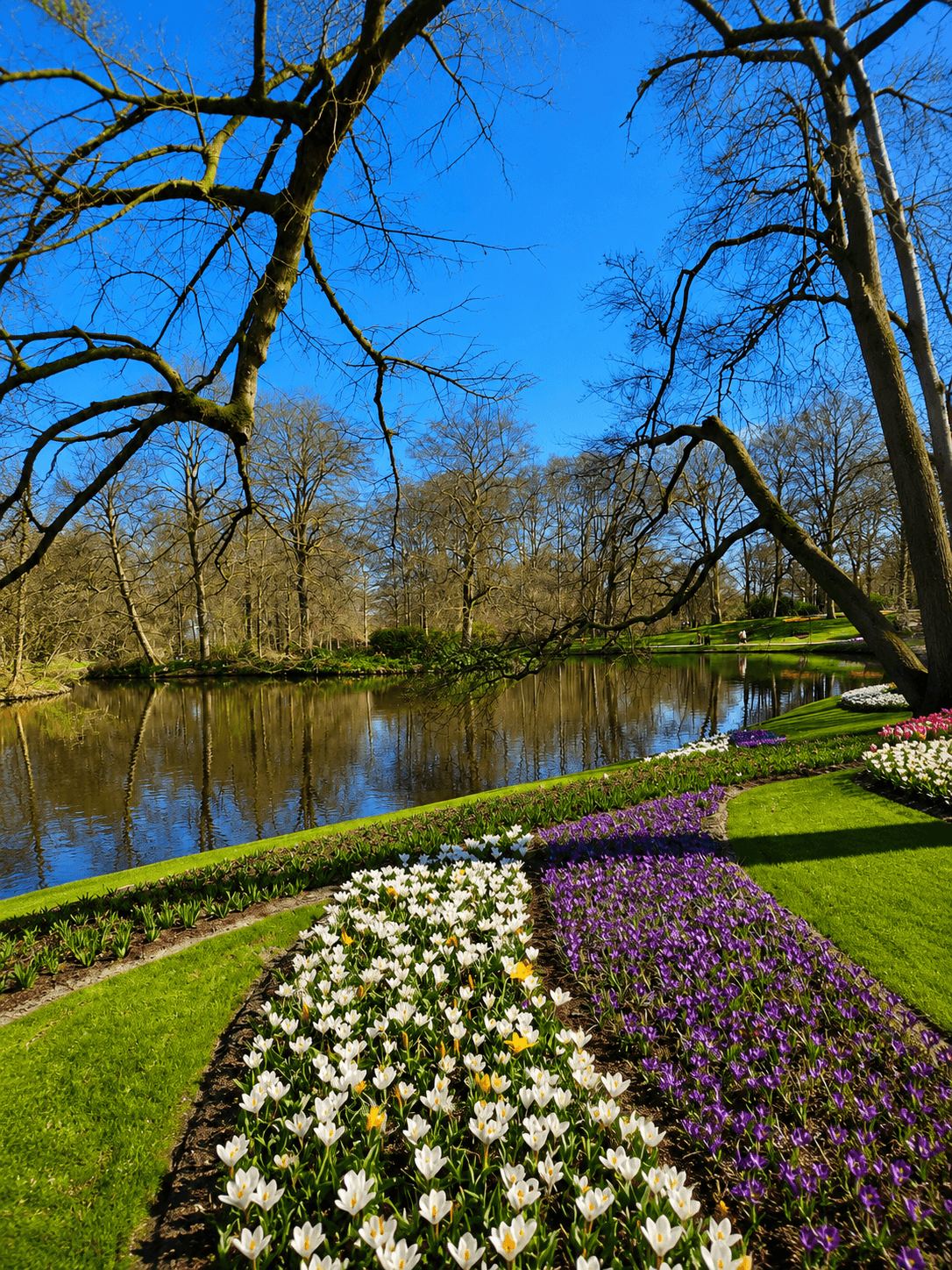
A quiet reflecting pond framed by early-season crocus beds.
Can You Do Both Keukenhof and the Open Fields?
Yes — and they genuinely complement each other rather than duplicating the same experience. Keukenhof gives you carefully designed floral combinations in a garden setting; the open fields give you the raw agricultural scale of a working flower industry. A cycling day through the Bollenstreek followed by a Keukenhof visit is a full and satisfying combination, though it requires timing carefully given Keukenhof’s timed entry structure.
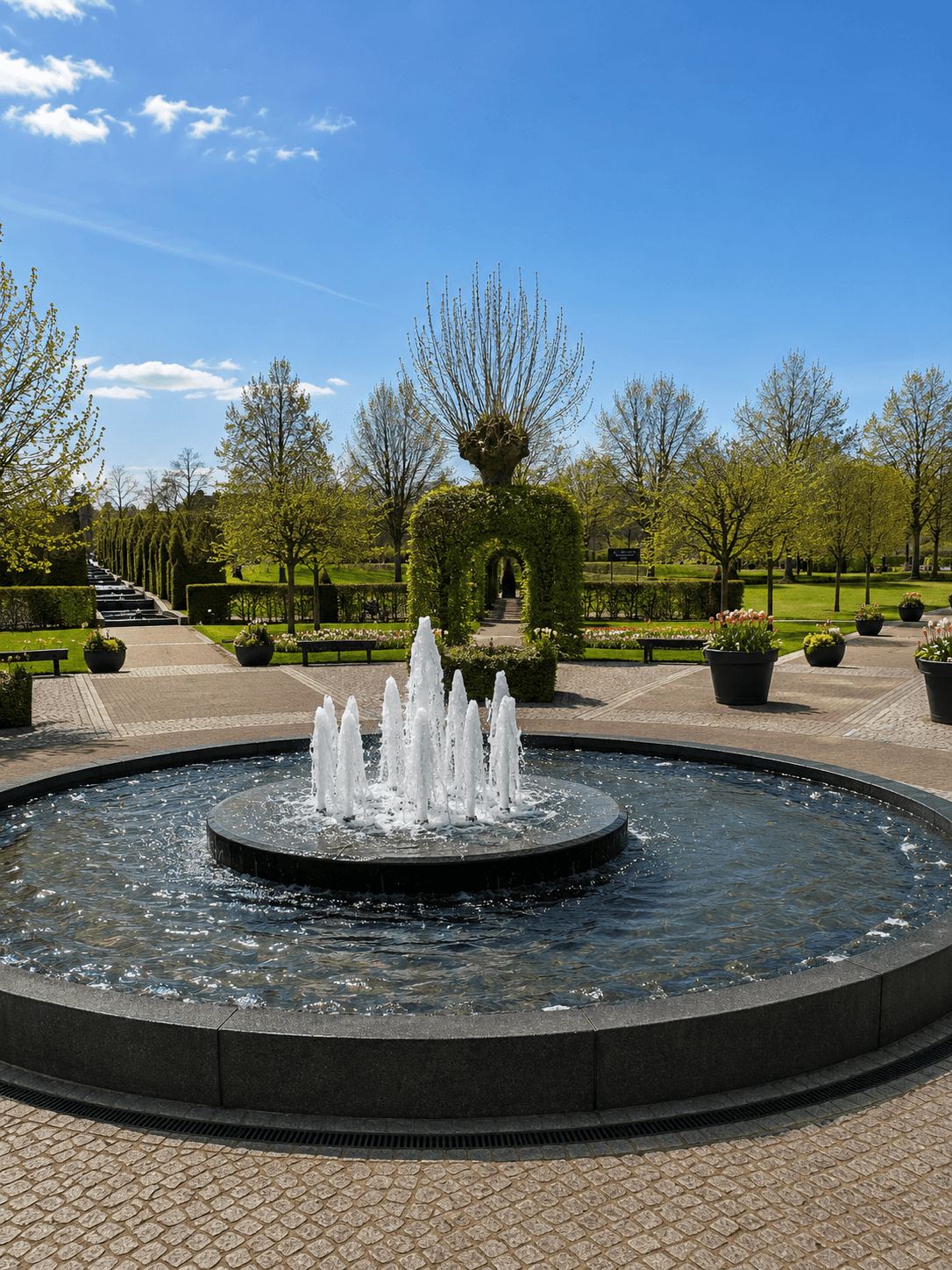
One of Keukenhof’s formal fountains, framed by clipped hedges.
Beyond Tulips: What Else Blooms
Tulips are the most famous, but the Bollenstreek growing season extends beyond them. Daffodils and crocuses appear in March, sometimes earlier in mild years. Hyacinths bloom alongside early tulips in late March to early April, bringing an intense fragrance to the fields. Late tulips and alliums extend the visible season into early May in some areas.
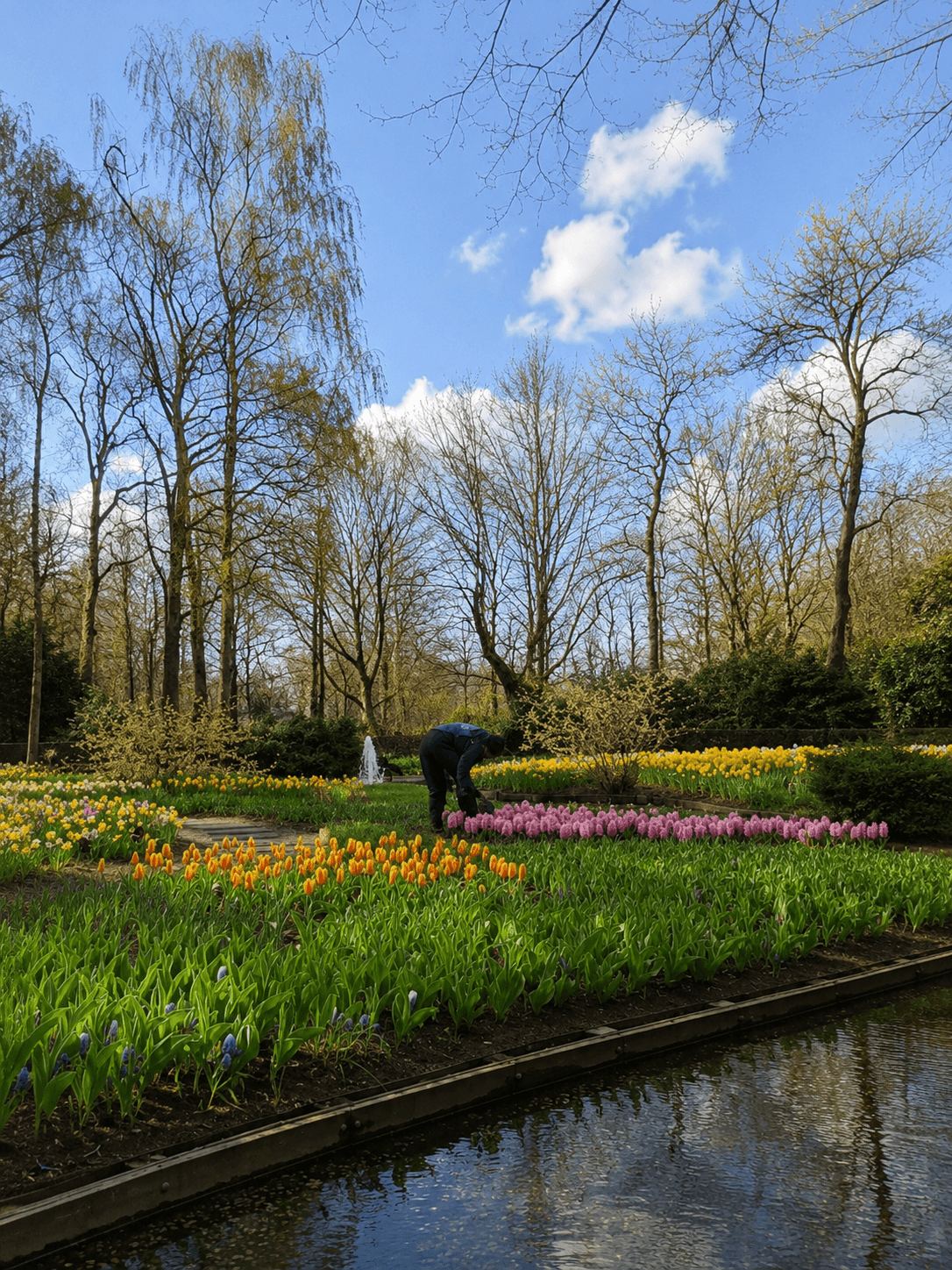
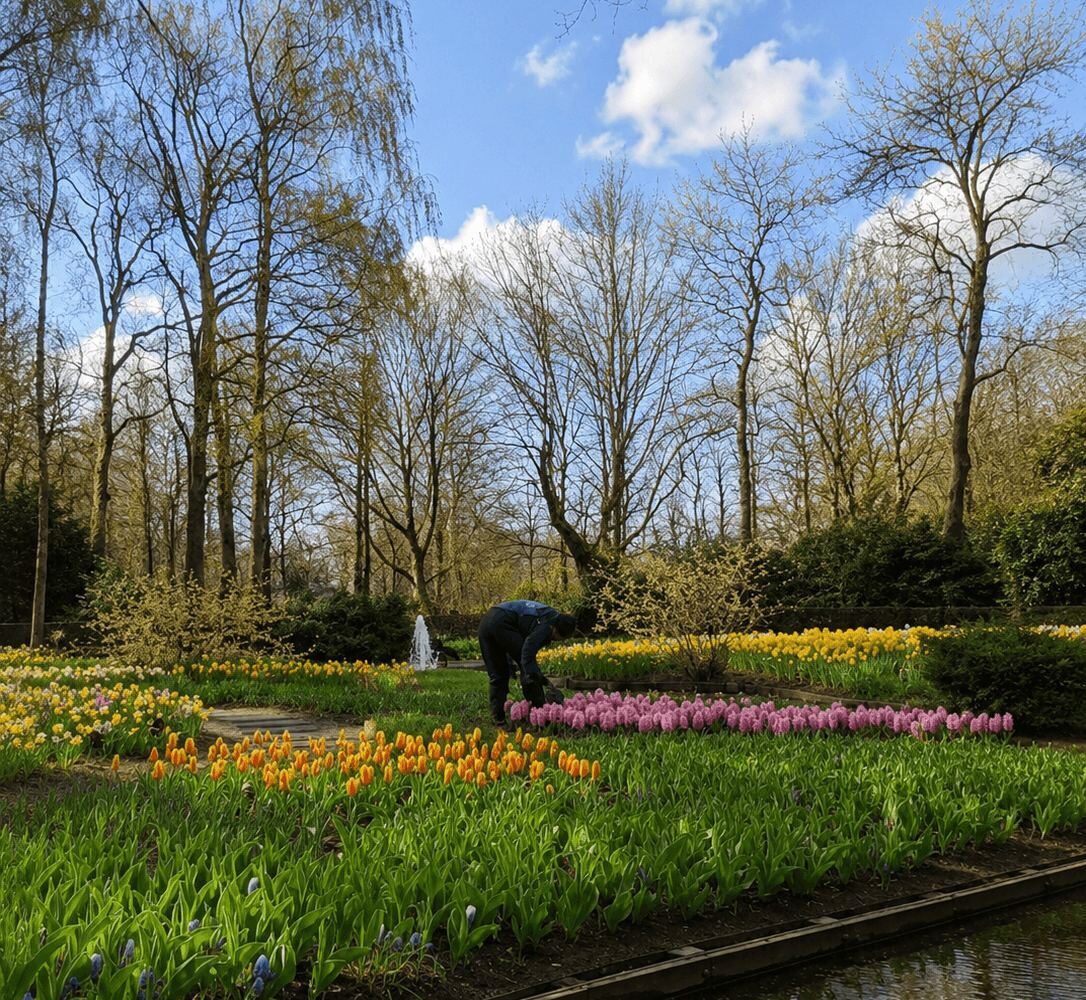
The daily upkeep behind Keukenhof’s famously tidy flowerbeds.
Understand the difference between a field and a flower garden
Keukenhof is a ticketed display garden planted to offer a sequence of flowers during its opening season. The surrounding bulb-growing landscape is working agricultural land, not a free extension of the park. A field may be spectacular for a short time and then be cut, harvested or less colourful than a photo from another year. Standing on a public road or cycle path to admire a field is different from walking into the crop for a portrait. Do not step between rows, climb over barriers or block a farmer’s gate. The right photograph can be taken from a permitted public viewpoint using the path as part of the composition. Visitors who want guaranteed, managed photo opportunities should look for an attraction that explicitly offers them; do not assume a grower has agreed to tourists entering an otherwise private field.
The Bollenstreek: where to focus your route
The area around Lisse, Hillegom and Noordwijkerhout is associated with bulb cultivation and can make a rewarding spring cycling excursion. The particular fields in bloom and their colours change with the season and farming decisions, so a fixed route copied from last year’s social media map is not a guarantee. Choose a starting point that works with your train, bus or parking arrangements and identify public cycling routes before setting out. If you rent a bicycle, ask about the return deadline, distance you can comfortably cover and whether the bike comes with a suitable lock. Use designated paths and obey temporary road restrictions. A shorter circuit with time to stop at legal viewpoints is more satisfying than a long loop that leaves you cycling back into a strong headwind. The coast can be a worthwhile extension if you have a full day, but it should remain optional when flowers are your main focus.
When should you go in 2027?
Keukenhof’s official 2027 opening dates are 18 March through 9 May. Those dates define the park season, not the exact beginning and end of flowering in every field. Early-season flowers can differ from the later tulip displays, and weather can move peak colour forwards or backwards. Check the official park’s bloom reports and current local visitor information shortly before travelling, especially if your holiday dates are flexible. A field that looked bright in an older travel article may be green or already harvested when you arrive. Avoid purchasing a rigid field-photo tour on the assumption that one specific crop will be blooming at one specific farm. If the forecast changes, a Keukenhof visit can offer a more structured alternative to a long exposed cycling trip, but read the park’s booking rules and entrance availability first.
A practical half-day flower route
For a half-day, choose either the Keukenhof garden or a modest cycling loop through the surrounding public roads. The garden involves a timed entry and substantial walking; an outdoor route involves transport to the starting point, a bike if needed, and much more dependence on weather. If combining them, leave an unhurried interval for lunch and allow enough time to return the bike. Do not try to visit several widely separated fields by bus without first checking whether those roads have practical public transport. For families, a short walk with good footwear and a nearby place to rest may be more useful than an ambitious cycling circuit. For photographers, consider the direction of light, safe stopping places and whether the path is wide enough to stand without obstructing other users. Every itinerary should work without entering a private field.
How to photograph flowers respectfully
Use a public verge only where standing is permitted and safe; many narrow rural roads have no convenient stopping area for cars. Do not pull over where you obstruct agricultural vehicles, and avoid placing a tripod across a busy cycle path. Keep the horizon, lines of colour and distant farms or churches in the frame instead of stepping into the crop to create a close foreground. If you want a portrait surrounded by flowers, find an organised pick-your-own garden or attraction that explicitly allows posed photography and follow its rules. A drone is not a shortcut: aviation, nature and privacy restrictions can apply, so check the official regulations before flying. Leave no litter, take care around wildlife and treat the fields as someone else’s livelihood. These principles matter even when many other visitors appear to be ignoring them.
The cheapest way to plan without making false promises
You can admire some fields from public routes without paying an admission fee, but transport, bicycle hire and any parking still cost money. Compare the full journey from Amsterdam rather than assuming “free tulips” means a free day trip. If you need a dependable garden visit with facilities, the ticketed Keukenhof experience may be a different kind of value from a weather-dependent cycle. For park dates, tickets and official directions, see Keukenhof. Our Haarlem and Keukenhof guide helps plan the transfer, while Dutch weather by month explains what to pack for exposed spring routes. Choose one feasible route with legal viewpoints, then allow the real seasonal conditions to determine what you photograph.
🙋 Frequently Asked Questions (FAQ)
Can you see tulip fields near Amsterdam for free?
Yes — the working bulb fields in the Bollenstreek area between Leiden and Haarlem are visible from public roads and cycling paths at no cost during bloom season, typically the second and third weeks of April.
Where exactly are the tulip fields near Amsterdam?
The main concentration of commercial bulb fields is in the Bollenstreek region between Leiden and Haarlem, roughly 30-45 km south-west of Amsterdam. Villages like Lisse, Hillegom, and Sassenheim are at the centre of the growing region.
When is the best time to see the tulip fields in bloom?
Peak bloom typically falls in the second and third weeks of April, though exact timing varies by a week or two each year depending on spring temperatures. Early risers on a clear morning in mid-April typically find the best combination of light and fully open blooms.
Is it better to see the tulips at Keukenhof or in the open fields?
They offer genuinely different experiences — Keukenhof is a curated garden with every species arranged for maximum visual impact, while the open fields give you the raw agricultural scale that makes the Netherlands’ flower industry visible. Both are worth seeing if your timing allows.
Final Recommendation
For the Keukenhof-specific approach, see our Haarlem to Keukenhof guide.
Plan Your Tulip Visit
🌷 Bloom timing updates: keukenhof.nl
🚲 Bollenstreek cycling routes: holland.com
🚂 Train & transit tickets: ns.nl
🏨 Compare accommodation prices: Booking.com
🗺️ Organised day trips & tours: GetYourGuide
🌍 Spanish-language tours & activities: Civitatis
Sources: bollenstreek.nl | keukenhof.nl| Details can change; check the linked official sources before booking