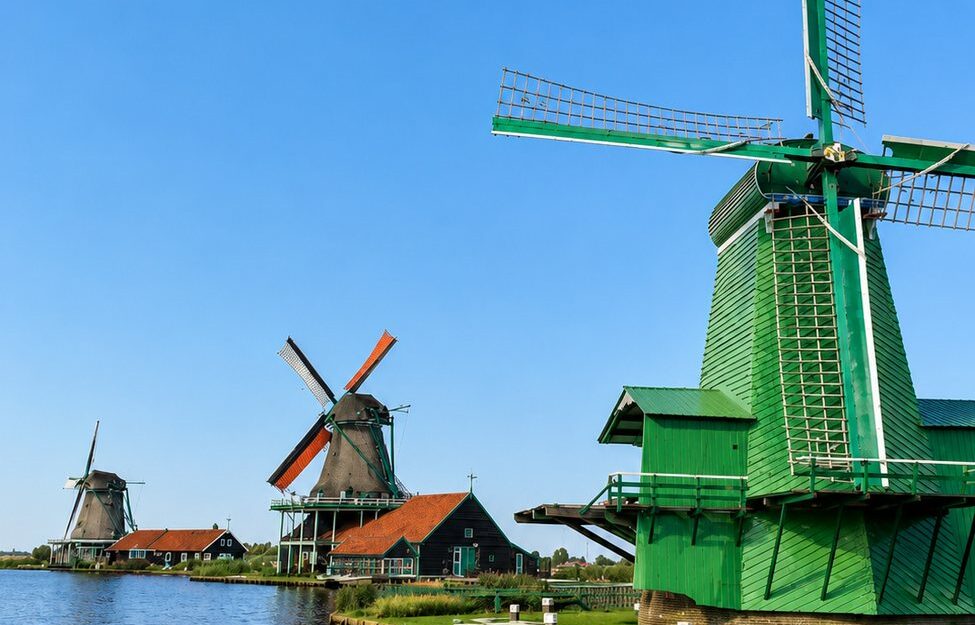
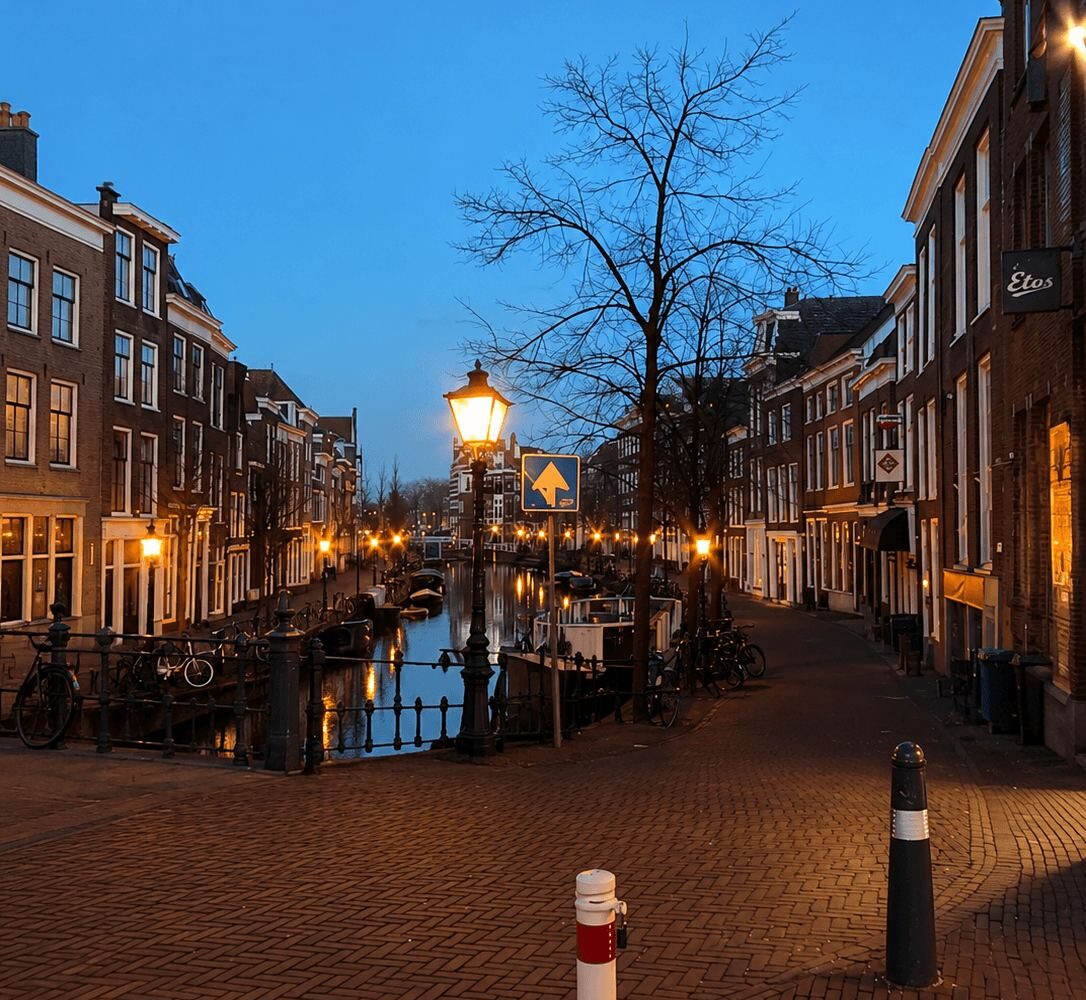
Leiden does not announce itself. There is no single landmark that dominates the skyline the way the Sint-Bavokerk dominates Haarlem or the windmills dominate Zaanse Schans. What Leiden has instead is a layered, richly textured city that gives up its best qualities slowly — through a narrow alley you almost walked past, through a canal reflection at the right time of day, through a restaurant hidden behind an unmarked door in a lane that tourists consistently miss.
I know this city well. The Burcht in the center of the city, the steegjes with their hidden restaurants, the park along the water at Molen de Valk on a warm afternoon — these are places that have stayed with me in a way that more conventionally photogenic destinations sometimes do not. Leiden is a city that gets into you quietly.
It is also, almost as a footnote, one of the most historically significant cities in the Netherlands: the birthplace of Rembrandt van Rijn, home to the oldest university in the country (founded 1575), and the site of one of the most celebrated sieges in Dutch history — a story that the city commemorates every year with a street festival so deeply local that most international visitors have never heard of it.
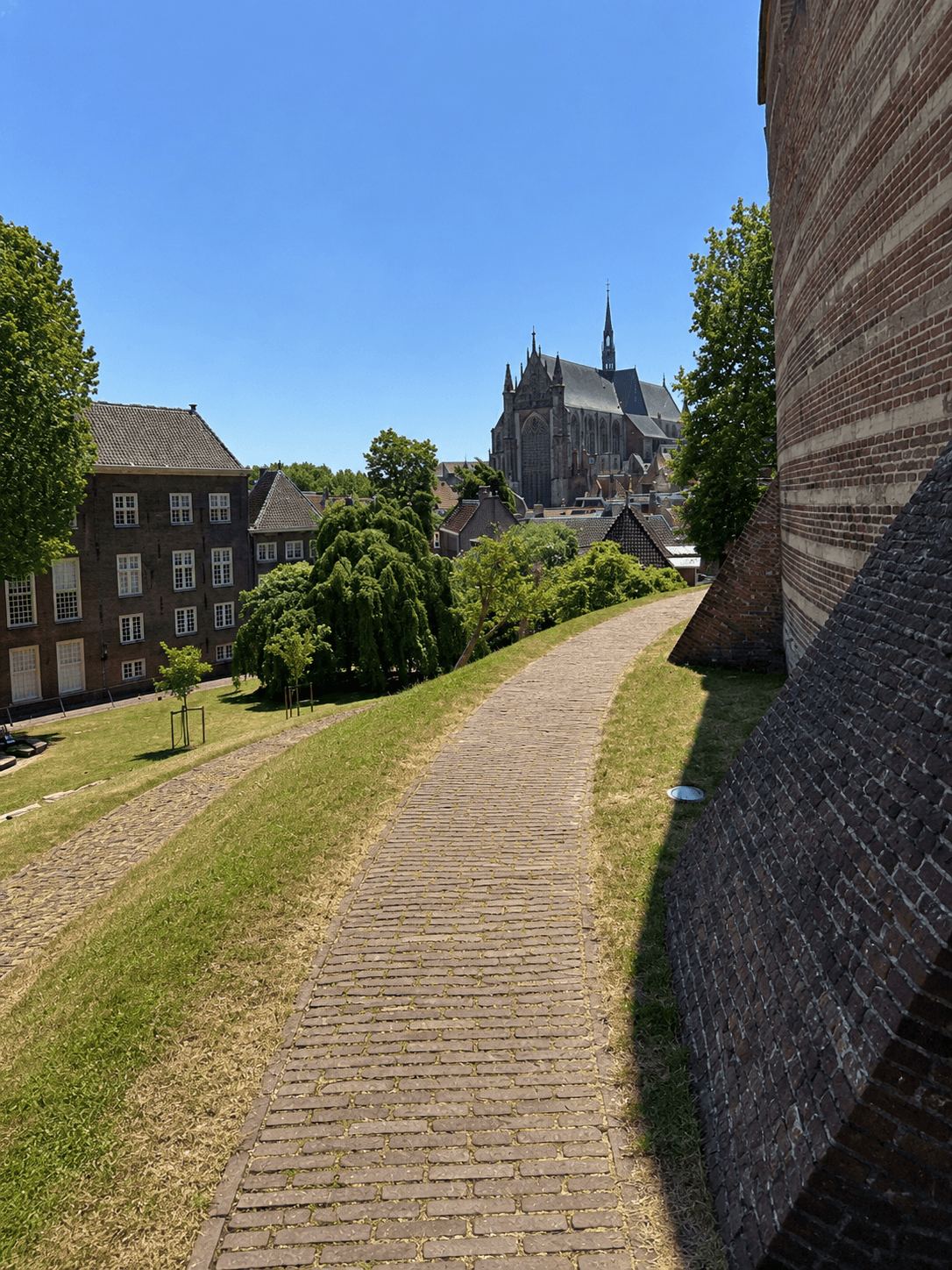
Leiden from above — the canal network, the stepped gables and the Burcht mound at the center. The view from the top of the Burcht looks exactly like this, and it costs nothing to climb.
Leiden at a Glance: Key Facts for Your Visit
| Detail | Information |
|---|---|
| Train from Amsterdam Centraal | ±35 minutes, direct Intercity, every 15 minutes |
| Train from Schiphol Airport | ±20 minutes, direct connection |
| Train from Haarlem | ±45 minutes via Amsterdam or direct via Schiphol |
| City Center Size | Compact — most highlights within 20 minutes on foot |
| Best Day to Visit | Any weekday; avoid Saturday afternoon in summer |
| Special Event | Leidens Ontzet — 3 October every year. Do not miss it. |
| Ideal Visit Length | 5 to 7 hours for a relaxed full day |
| Don’t Miss | De Burcht, Naturalis, the steegjes, Molen de Valk, Pieterskerk |
The Burcht: The View That Defines the City
The Burcht van Leiden is a circular fortress built on top of an artificial mound — a motte — in the exact geographical center of the city, at the confluence of the Old and New Rhine. It dates to the 11th century, and for nearly a thousand years it has been the highest point in the city center.
The climb takes approximately three minutes. You walk from the street level up a stone staircase to the base of the mound, then up a second flight of steps through the gate of the circular keep. At the top, the parapet walk runs all the way around the outer wall, giving you a full 360-degree view over the rooftops, canals, and church towers of Leiden in every direction.
The Burcht is a historic viewpoint; check current access and any restrictions before visiting, particularly around special events. The trick is to go early in the morning before the school groups arrive, or in the late afternoon when the light across the rooftops turns warm and the canal reflections are at their most photogenic. From the parapet you can plan your entire day in Leiden by simply looking at where everything is.
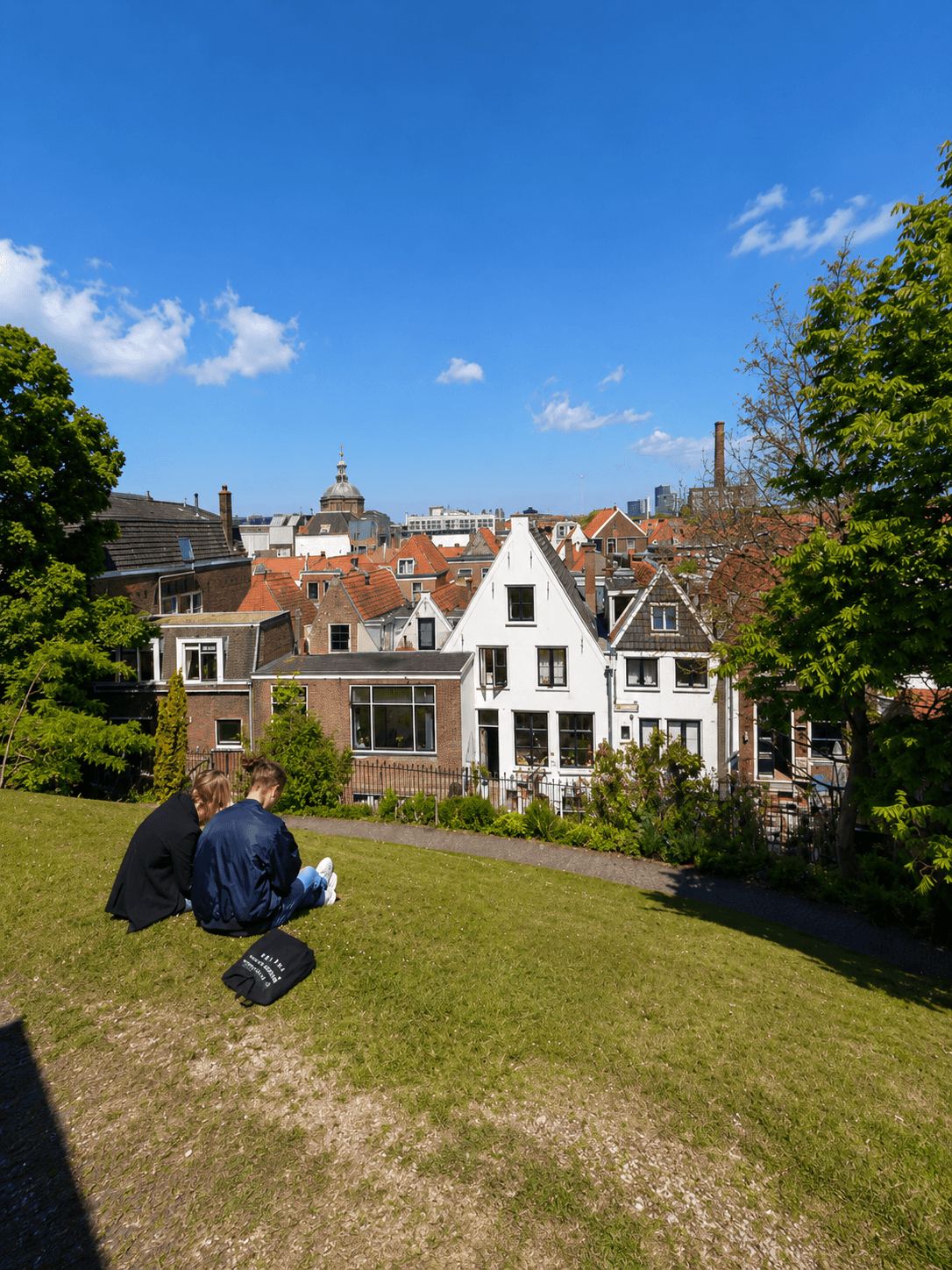
The view from the Burcht parapet — the full 360-degree panorama of Leiden’s canal city. Free to enter, three minutes to climb, impossible to forget.
Leidens Ontzet: The Festival Every Visitor Should Know About
🎉 Leidens Ontzet — 3 October
If you are visiting Leiden in early October, there is one date you need to build your entire itinerary around: 3 October. This is Leidens Ontzet — the annual commemoration of the relief of the Siege of Leiden in 1574 — and it is one of the most genuinely local, un-touristy, and historically rooted street festivals in the entire Netherlands.
The entire city participates. The streets fill from early morning. Traditional food stalls appear on every corner. And the two dishes you must eat are hutspot and white bread with haring.
The Story Behind the Festival
In 1574, Leiden was under siege by Spanish forces for 131 days. The city was starving. On 3 October, the Dutch Sea Beggars — the Watergeuzen — broke through the Spanish lines by flooding the polders and sailing their flat-bottomed ships directly across the submerged farmland to relieve the city. According to legend, the Spanish troops fled so quickly that they left a pot of hutspot — a stew of carrots, parsnips, and onions — still cooking on their campfire. A hungry boy named Cornelis Joppensz found it and brought it to the starving citizens.
Whether the legend is entirely accurate is beside the point. What matters is that Leiden has commemorated this moment every single year since 1574 — making Leidens Ontzet one of the oldest continuously celebrated city festivals in the Netherlands. The city takes it seriously. Not as a tourist event, not as a marketing exercise, but as a genuine community tradition that locals feel personally connected to.
What Happens During Leidens Ontzet
- Hutspot distribution: Traditional hutspot stalls open from early morning across the city center. The recipe — carrots, parsnips, potatoes, onions — is the same as the one that has been cooked in Leiden on 3 October for 450 years.
- White bread with haring: Fresh raw herring on soft white bread, served at fish stalls throughout the city. A combination that sounds simple and tastes extraordinary in context.
- Fireworks: The evening of 3 October ends with a large fireworks display visible from the Burcht and the canal banks.
- Funfair and market: A large funfair runs on the Beestenmarkt and surrounding squares, with market stalls throughout the medieval center.
- Historical reenactments: Figures in period costume recreating the relief of the siege appear throughout the day in the streets near the Pieterskerk and along the canals.
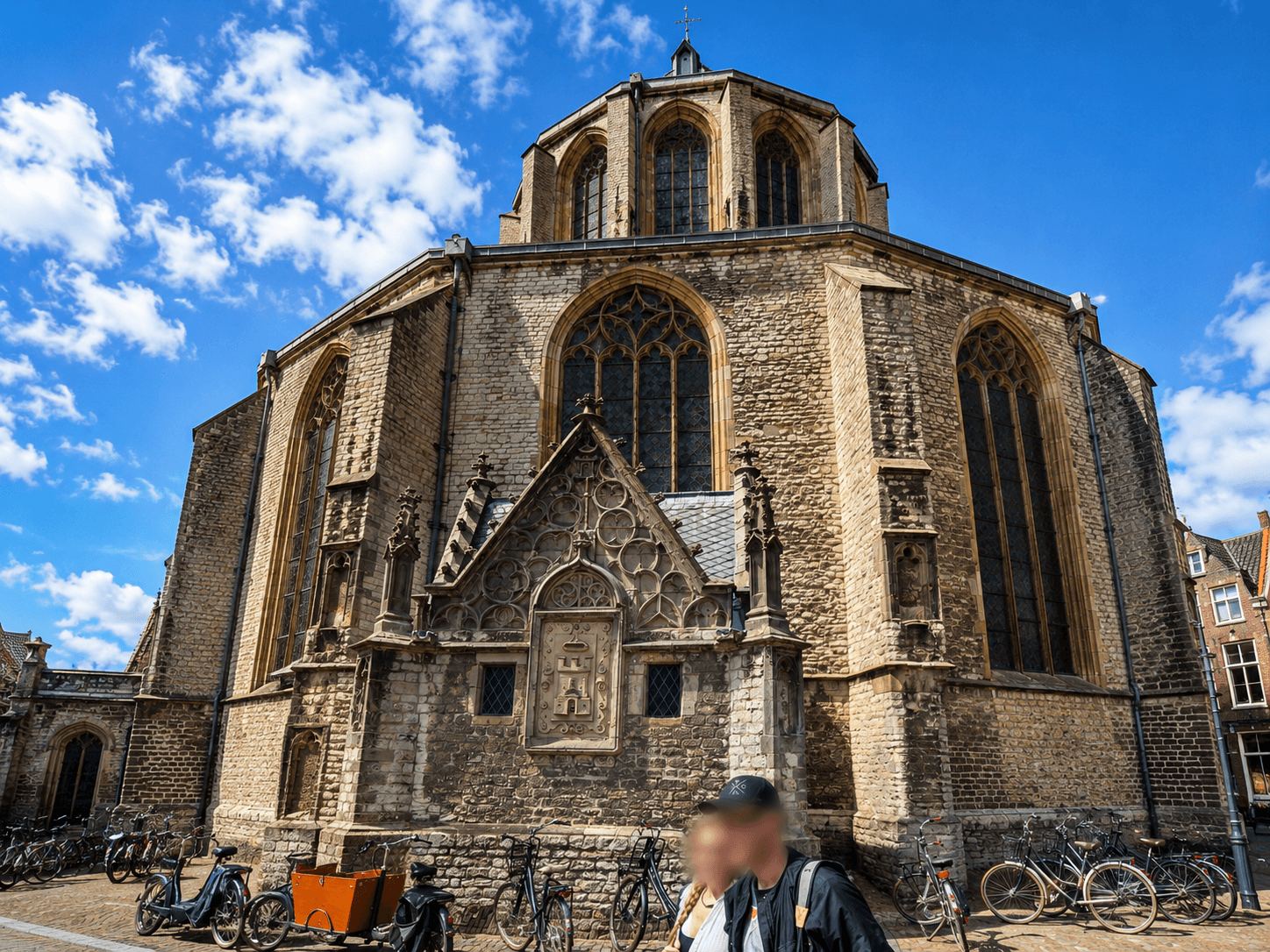
The Gothic exterior of the Hooglandse Kerk, with bicycles parked beside the church.
Naturalis: The Museum That Surprises Every Visitor
Of all the recommendations in this guide, Naturalis Biodiversity Center is the one that most consistently surprises visitors who arrive expecting a standard natural history museum and leave having spent twice as long as they planned.
Naturalis is the national natural history museum of the Netherlands, and the building that opened in 2019 is genuinely world-class — both architecturally and in terms of the collection it houses. The exterior is a copper-clad oval that sits in the middle of the Bio Science Park just east of the city center, visible from the top of the Burcht on a clear day. Inside, the design is open and fluid, with the collection arranged across multiple floors around a central atrium.
The standout exhibit — and the reason you should buy your ticket in advance — is Trix, one of the most complete Tyrannosaurus rex skeletons ever found. Trix was discovered in Montana in 2013 and is displayed in Naturalis in a purpose-built hall that allows you to walk completely around the skeleton at close range. The scale of the animal at that proximity is viscerally different from seeing it in a photograph.
Naturalis is the kind of museum that works across the full age range simultaneously. Children run toward the dinosaur. Adults find themselves stopping in front of the mineral collection or the insect cases and losing track of time entirely. I have been with people who said they would stay for an hour and ended up spending the entire afternoon. Budget more time than you think you need.
Beyond Trix, the permanent collection covers evolution, geology, human biology, and the biodiversity of the Netherlands in exhibits that are designed with more intelligence and visual clarity than most comparable natural history institutions in Europe. The temporary exhibition programme is consistently strong. Check the current schedule at naturalis.nl before you visit.
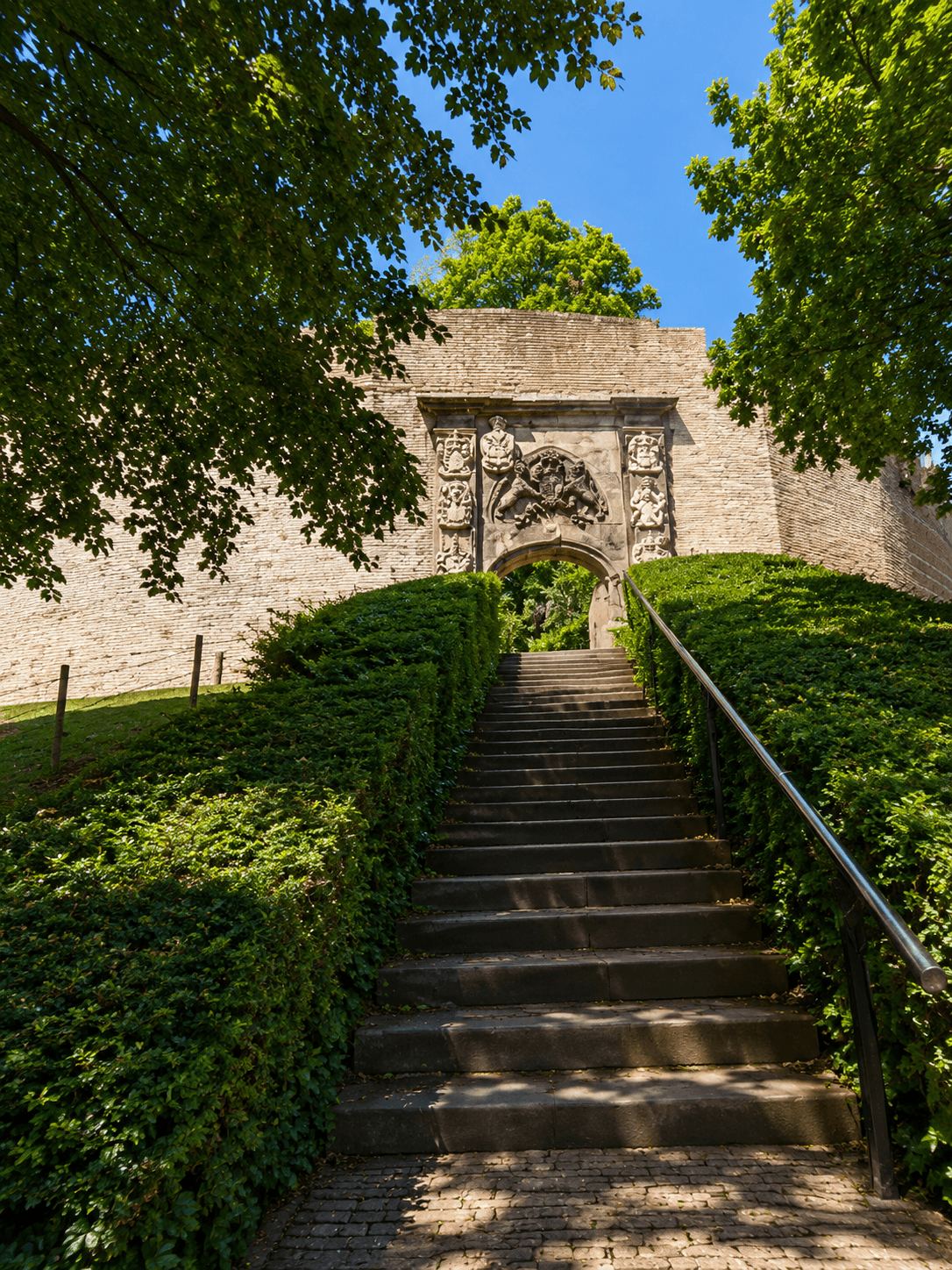
The stone steps leading through the greenery to the Burcht van Leiden.
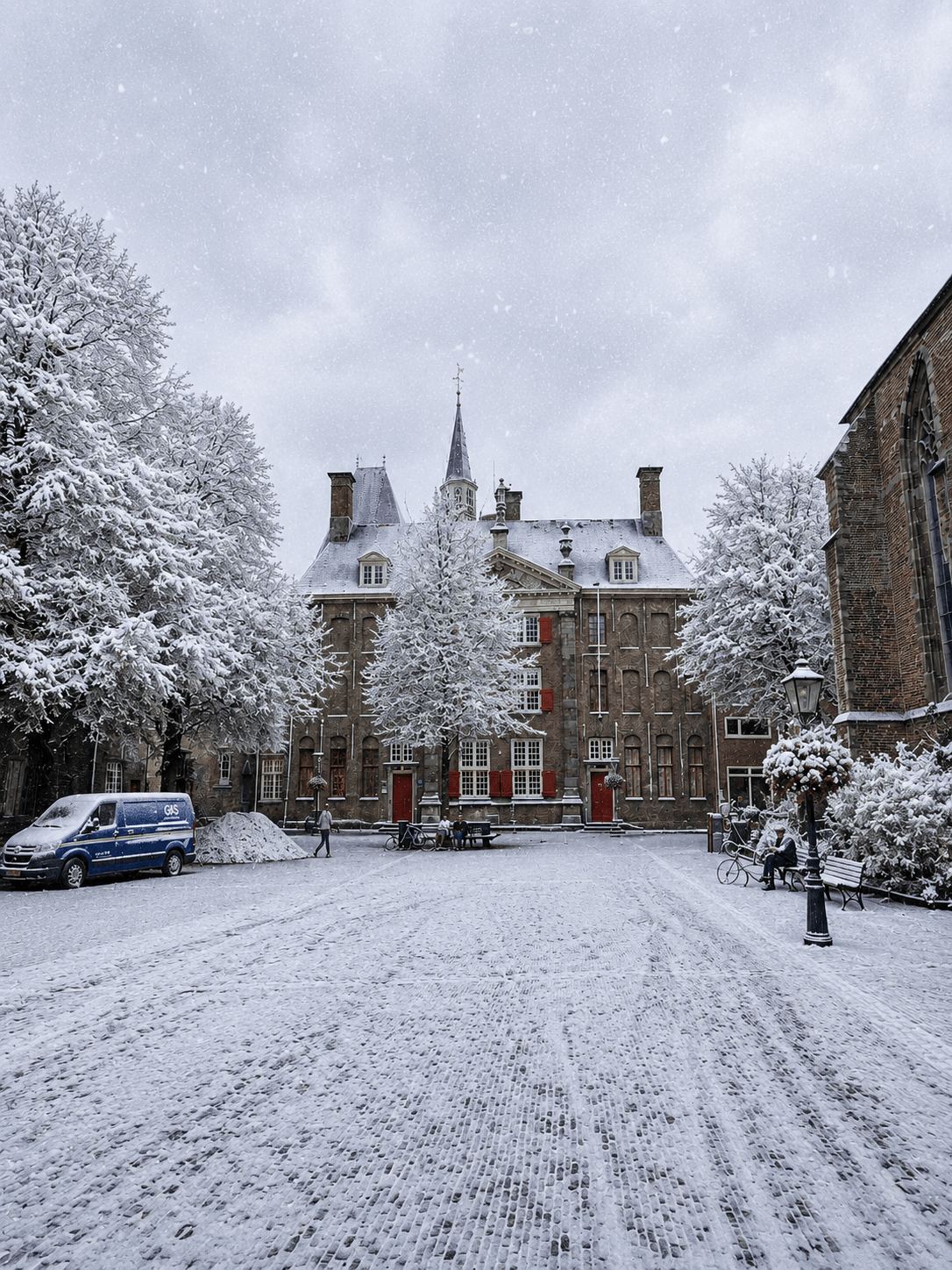
A historic Leiden square and gabled building during a rare snowfall.
The Steegjes: Leiden’s Hidden Restaurant Lanes
The word steegje means alley or narrow lane, and Leiden’s historic center is threaded with them — passages barely wide enough for two people to pass each other, running between the main canal streets, often unmarked, frequently overlooked. Many of these alleys contain some of the best places to eat in the city.
This is not a coincidence. The steegjes were the service routes and the trade passages of the medieval city, and the buildings along them were warehouses, workshops, and the smaller domestic structures that supported the canal-front wealth. As the city’s economy shifted over the centuries, these lanes became the spaces where informal enterprise persisted — the small eateries, the independent coffee shops, the kitchen-focused restaurants that could not afford the canal-front rents but produced better food than many that could.
What to Look For
The best steegje restaurants in Leiden share certain qualities: they are small, usually with no more than thirty covers; they have menus that change frequently because they are built around whatever is available that week; and they are almost never advertised with the kind of visible signage that draws passing tourists. The most reliable indicator is a chalkboard menu in a window, a full dining room at lunchtime on a Tuesday, and the absence of photographs on the menu.
The area around the Pieterskerkgracht and the Kloksteeg — the lane running alongside the Pieterskerk — has the highest concentration of genuinely good eating in the city center. The Kloksteeg itself, despite running alongside one of Leiden’s most visited landmarks, manages to remain largely local in character. Walking its length slowly, looking through windows and at door frames, is one of the more reliable methods of finding where to eat in Leiden.
The Diefsteeg — the “Thief’s Alley,” running from the Breestraat toward the Rapenburg canal — is narrower still, and contains several places that have been serving lunch to university staff and students for decades without ever appearing in a travel guide. These are not secret. They are simply not visible to people who walk the main routes.
The rule I follow in Leiden is this: if you can see the restaurant from a canal bridge or from the main shopping street, it is probably aimed at you as a visitor. If you have to make two turns and walk down a lane that makes you briefly uncertain you are going the right way, you are probably about to eat something better.
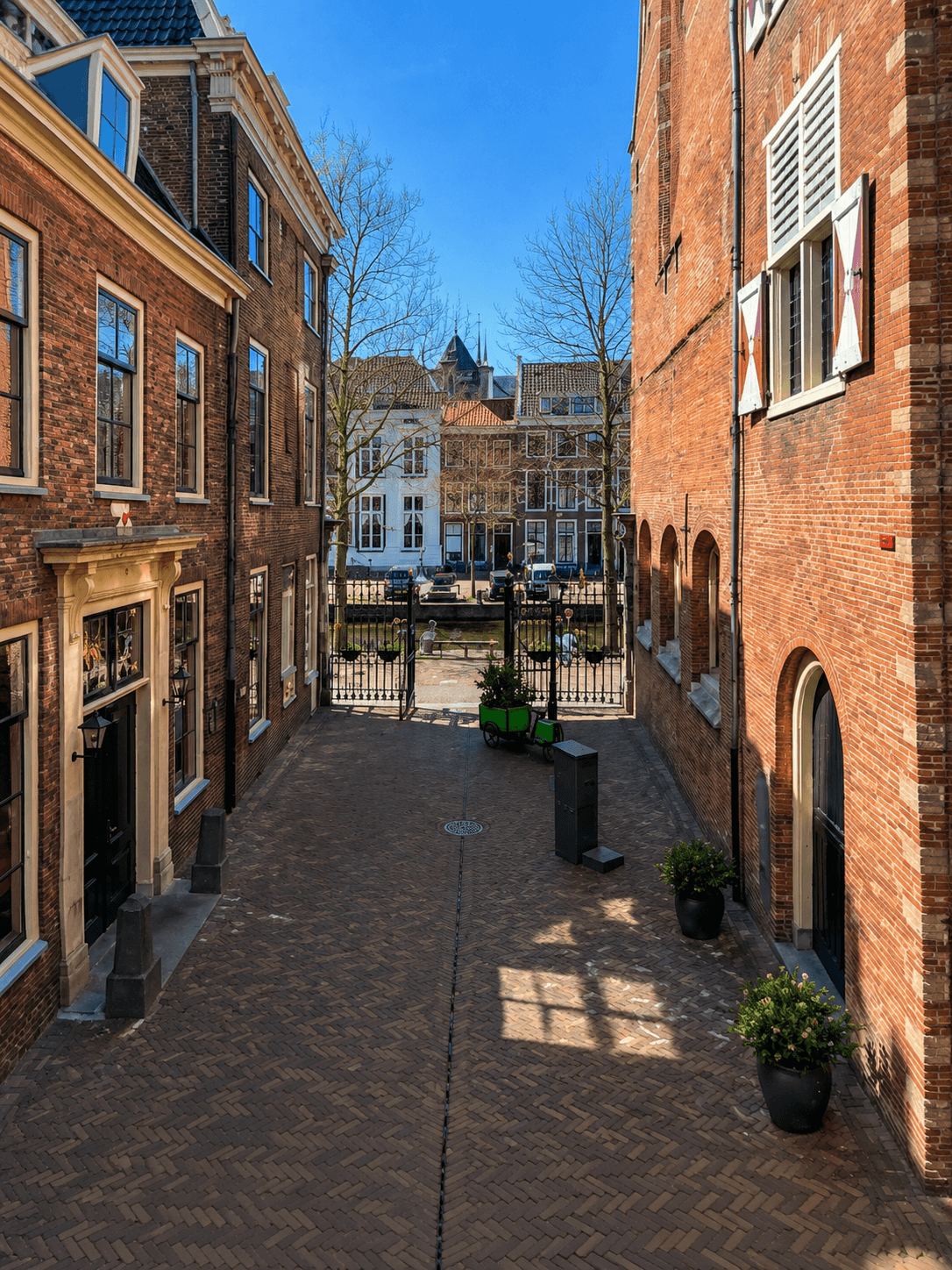
A typical Leiden steegje — barely wide enough for two people, an unmarked door, a chalkboard menu in the window. This is where the good food is.
Molen de Valk and the Park: Where Leiden Breathes
Molen de Valk — the Falcon Mill — is a seven-story corn mill built in 1743 on the site of an earlier windmill that had stood there since the 16th century. It stands at the edge of the historic center where the Langegracht meets the Rijnsburgersingel, and the open space around its base functions as one of the most pleasant informal parks in the city.
The mill itself is a museum — you can climb through all seven floors of the working structure, from the grain storage at ground level through the millstone floors to the cap at the top, where the sails turn within arm’s reach and the view across the surrounding canal network is among the best in Leiden. It is a smaller, more intimate experience than the industrial mills at Zaanse Schans, with a personal quality that comes from it being essentially a preserved family home as well as a working mill — the miller’s quarters on the lower floors are intact, with original furniture and domestic objects.
The combination of the mill visit and the park makes this the natural end point of a day in Leiden. After the Burcht, Naturalis, the Pieterskerk, and a steegje lunch, the walk south along the Langegracht to Molen de Valk takes approximately fifteen minutes and delivers you into the kind of unhurried afternoon space that the rest of the day earns.
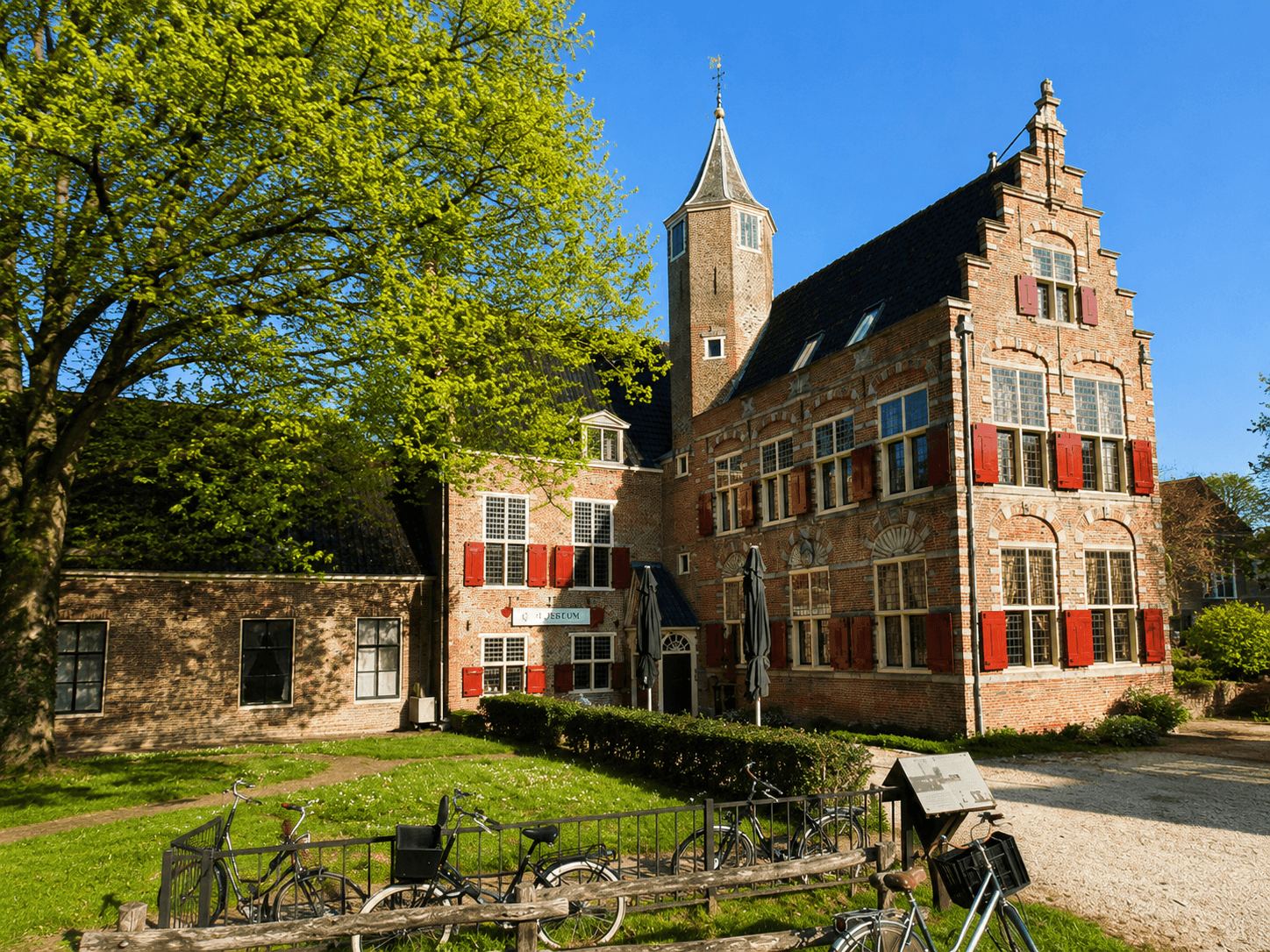
A historic brick manor house with red shutters and a corner tower near Leiden.
The Hortus Botanicus: Gardens and Botanical History
The Hortus Botanicus Leiden is one of the oldest botanical gardens in the world, founded in 1590 as the university’s academic medicinal herb garden. It sits on the Rapenburg canal, a ten-minute walk from the Pieterskerk, and most visitors who pass its entrance have no idea that the garden inside contains one of the most significant plants in the economic history of the Netherlands.
In 1593, a Flemish botanist named Carolus Clusius was appointed professor at the University of Leiden and brought with him a collection of bulbs he had been cultivating in Vienna. Among them was a Turkish flower that had never been commercially grown in the Netherlands before: the tulip. Clusius planted them in the Hortus and began systematic cultivation and study. Within decades, the tulip had spread from the Hortus Botanicus Leiden into the surrounding farmland of South Holland, triggering the bulb-growing industry that today fills the fields of Lisse, Sassenheim, Hillegom, and Voorhout every spring.
The garden today covers a beautifully maintained area of approximately 1.5 hectares, with a remarkable collection of plants spanning five centuries of botanical history. The Clusius Garden — a dedicated reconstruction of the original 1594 garden layout — is planted exactly as it would have been in Clusius’s time, with the original medicinal and botanical species arranged in the same geometric beds. Walking through it connects you directly to the moment when the Dutch Golden Age flower trade began.
If you have cycled through the Keukenhof tulip fields or driven past the Bollenstreek in April and wondered how it all started — the answer is here, in a walled garden on the Rapenburg canal in Leiden, in a tulip bed planted by a Flemish botanist in 1593.
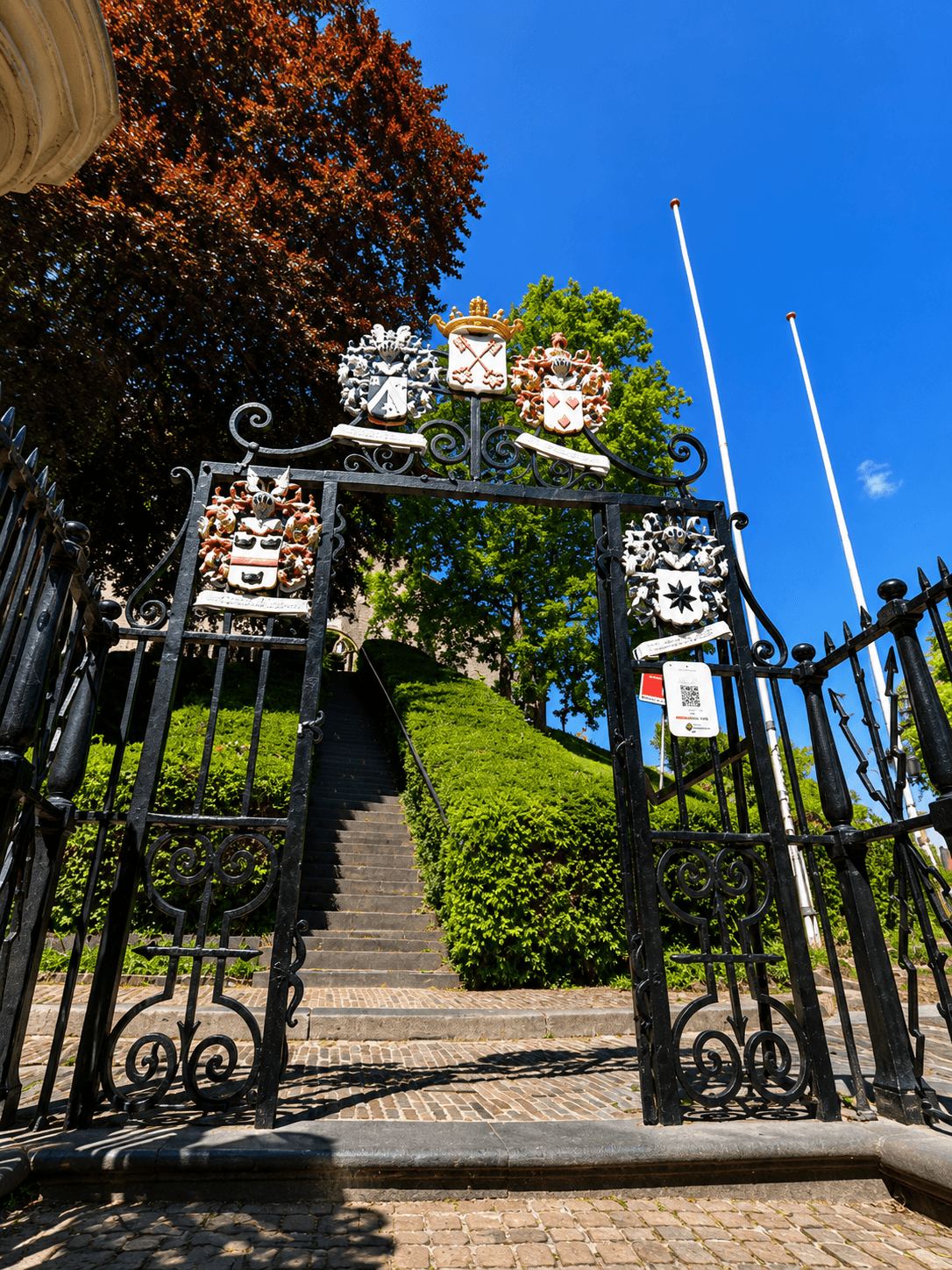
The heraldic wrought-iron gate at the entrance to the Burcht van Leiden.
Walking in Rembrandt’s Leiden
Rembrandt Harmenszoon van Rijn was born in Leiden on 15 July 1606, the ninth child of a miller. His father ran a mill on the Galgewater canal — a working-class part of the city near the current Molen de Valk — and Rembrandt spent the first twenty-five years of his life in Leiden before moving to Amsterdam in 1631 and never returning to live here again.
Leiden does not have a Rembrandt museum. This is either a scandal or a mark of honest restraint, depending on your perspective — the city’s most famous son left virtually nothing physical behind, and an institution built around his absence would feel unconvincing. What Leiden has instead is a city that shaped him: the canals, the light on the water, the textures of the working neighborhoods where he grew up, and the university atmosphere that surrounded him from childhood.
What to See
A plaque on the Weddesteeg marks the approximate site of the house where Rembrandt was born. The house itself no longer stands — it was demolished in the 19th century — but the Weddesteeg is one of Leiden’s older lanes, and the scale and character of the street gives a genuine sense of the working-class neighborhood Rembrandt grew up in.
The Galgewater canal, running south from the city center, was where his father’s mill stood. Today it is one of the quieter, more atmospheric waterways in Leiden, lined with houseboats and overlooked by the back gardens of the canal houses. The light on the Galgewater in the early morning — low, diffuse, falling across still water and brick — is the kind of light that appears in Rembrandt’s early work. Standing on the bridge over the Galgewater at 9 AM, it is not difficult to understand where it came from.
The Pieterskerk was where Rembrandt was baptized and where he attended services throughout his Leiden years. The Leiden University Academy Building on the Rapenburg was the institution he enrolled in briefly at age fourteen — younger than the minimum age, on a special dispensation — before deciding that painting was what he wanted to do. The walk from the Weddesteeg to the Rapenburg to the Galgewater takes approximately twenty minutes and covers the geography of Rembrandt’s entire Leiden life.
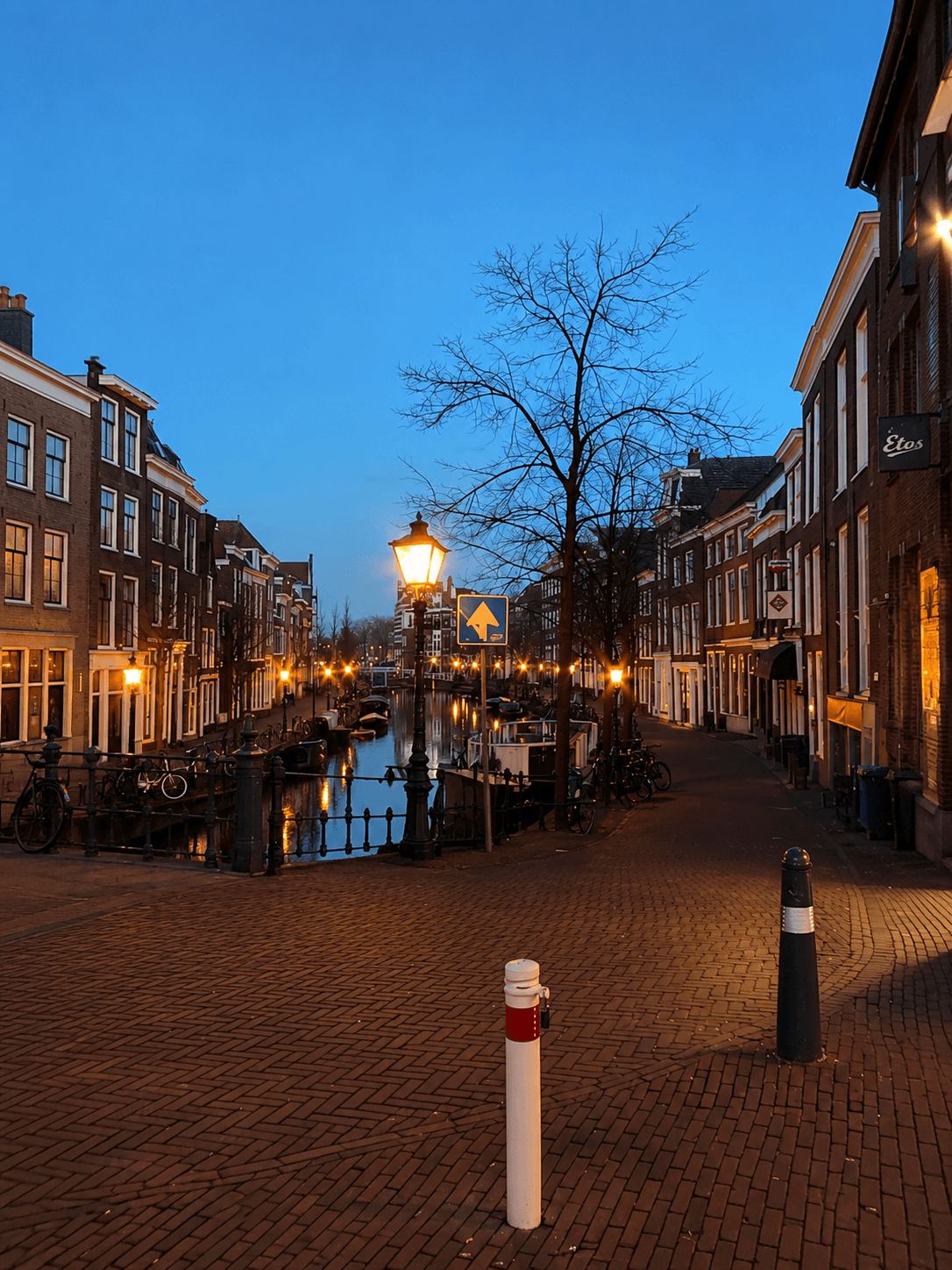
The quiet, lamplit quality of light along Leiden’s smaller canals — the Galgewater itself, where Rembrandt’s father ran a mill, still carries this same soft morning and evening light today.
More to See in Leiden
- Pieterskerk: The main Gothic church of Leiden, burial place of John Robinson — the pastor of the Pilgrim Fathers, who departed for the New World from Leiden in 1620. Free to enter. One of the finest medieval interiors in South Holland.
- Rijksmuseum van Oudheden (National Museum of Antiquities): One of the best archaeology museums in Europe, with an Egyptian temple — the Temple of Taffeh, a gift from the Egyptian government — installed permanently in the entrance hall. World-class Greek, Roman, Egyptian, and Dutch antiquities.
- The Rapenburg: The most beautiful canal in Leiden — a broad, tree-lined waterway through the heart of the university quarter. The university’s Academy Building faces directly onto it, and the canal-front architecture here is some of the finest in the Netherlands.
- The Saturday Market on the Nieuwe Rijn: A large weekly market running along the canal every Saturday morning — flowers, vegetables, cheese, fish and clothing stalls along one of the most attractive market settings in South Holland.
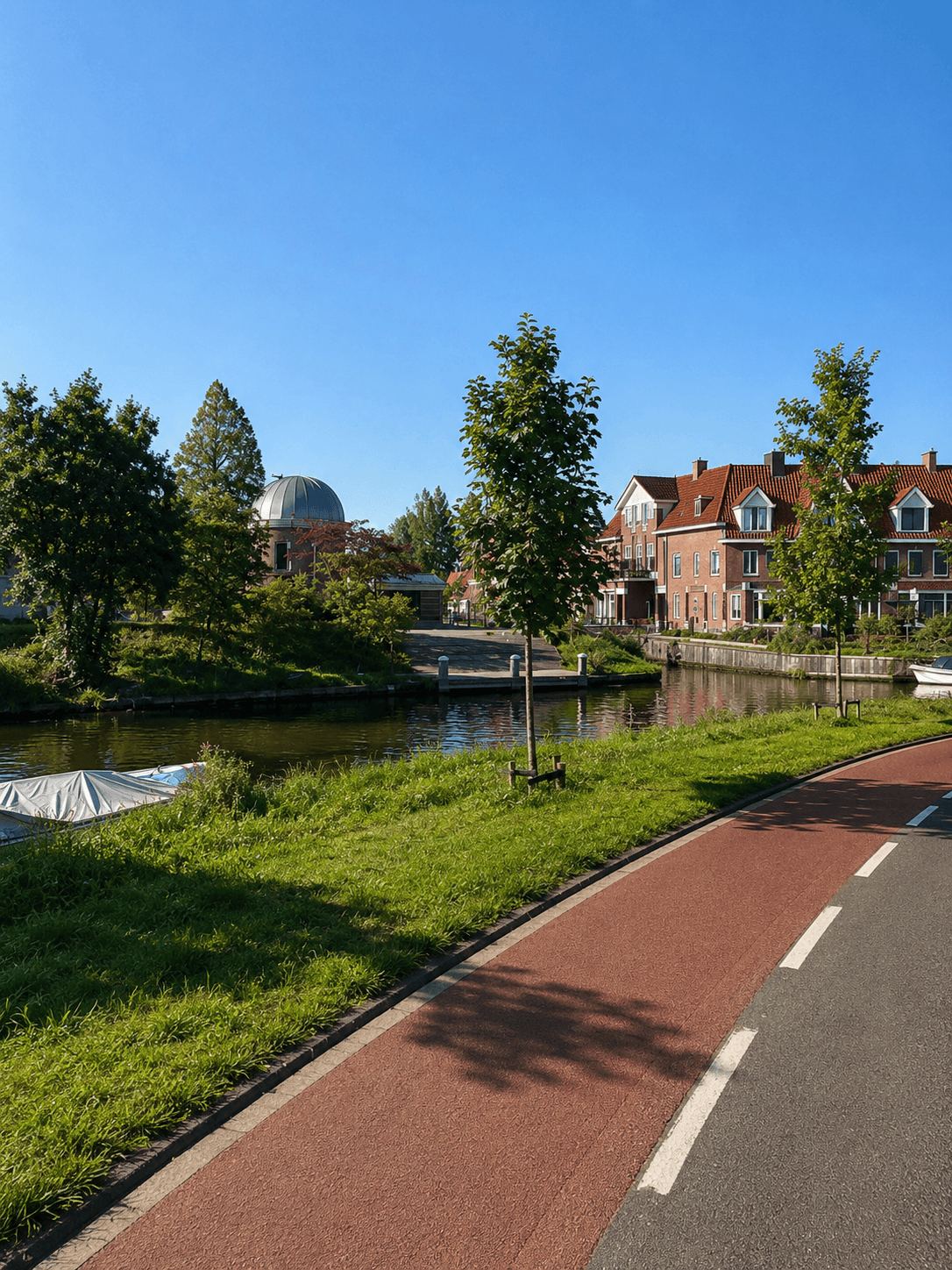
The Rapenburg canal — the most beautiful street in Leiden, running through the heart of the oldest university in the Netherlands.
Where to Eat in Leiden: The Best Restaurants
The Golden Rule: Follow the Steegjes
The best eating in Leiden is consistently in the narrow lanes rather than on the canal fronts. The Kloksteeg alongside the Pieterskerk and the Diefsteeg running from the Breestraat toward the Rapenburg are the two to start with — small kitchens, frequently changing menus, priced for the university community rather than passing visitors.
Specific Restaurants Worth Knowing
In den Doofpot on the Tunnelstraat is one of the most established restaurants in the city — a Dutch kitchen with a long track record and a loyal local clientele. The name translates roughly as “put to rest” or “hushed up,” which is a reasonable description of how the restaurant has operated: quietly excellent for years without needing to shout about it.
Oudt Leyden on the Steenstraat is the restaurant you go to when you want a meal that is specifically and unapologetically Dutch. Traditional stamppot, hutspot, and seasonal Dutch classics served in a setting that has been feeding Leidenaars for decades. If you want to understand what Leiden actually eats when it is eating Dutch food rather than Indonesian takeout, Oudt Leyden is the place.
Verboden Toegang — “Forbidden Entry” — is a Leiden institution. Located on the Rapenburg, it is a café-restaurant with a canal-side terrace that is one of the most pleasant outdoor eating spots in the city during good weather. The name refers to a notice board outside, and the restaurant has been trading successfully on the contradiction ever since. The kitchen is solid, the wine list is reasonable, and the terrace in late afternoon is genuinely hard to leave.
De Waag on the Aalmarkt, occupying a beautiful historic building on the canal, serves a broad Dutch and European menu in a space that is large enough to accommodate groups without losing atmosphere. The building itself — a former weigh house on the water — is worth seeing regardless of whether you eat there.
Rosto on the Breestraat brings serious pizza technique to Leiden in a setting that is efficient, affordable, and consistently well executed. It has become a firm favourite with university staff and students who want something fast, good, and not overpriced in the center of town. Arrive early for lunch — the queue forms quickly.
Lunch in Leiden
For a relaxed midday meal, the area around the Pieterskerkplein has several well-positioned options with outdoor seating in good weather. Alternatively, pick up food from the Saturday market on the Nieuwe Rijn and eat on the canal bank — Dutch cheese, fresh stroopwafels, herring from the fish stall — for a different, considerably cheaper midday experience.
Dinner in Leiden
For dinner, Leiden’s diversity shows. The area around the Korevaarstraat and the Haarlemmerstraat has independent restaurants serving Indonesian, Surinamese, and modern European food. For a traditional Dutch dinner after a day in the city, the brown cafés around the Beestenmarkt serve stamppot, erwtensoep, and winter staples that you genuinely cannot find better anywhere in South Holland.
Leiden vs. Haarlem: How to Choose
Both cities deserve a full day, and both sit within 45 minutes of Amsterdam by train. The honest comparison comes down to what kind of day you want.
| Feature | Leiden | Haarlem |
|---|---|---|
| Travel time from Amsterdam | ±35 minutes by train | ±15 minutes by train |
| Flagship museum | Naturalis — national natural history collection | Frans Hals Museum — world-class 17th-century painting |
| Unique annual event | Leidens Ontzet on 3 October — entire city in the streets | None comparable |
| Student atmosphere | Stronger — oldest university in the Netherlands (1575) | Strong — Novitas student association, Zeilstraat café culture |
| Architecture | More intimate — canals and alleys at human scale | More monumental — Sint-Bavokerk dominates the skyline |
| Crowd levels | Lower — fewer international tour groups | Moderate — busier on weekends and in summer |
| Beach access | Limited — Katwijk accessible by bus (±30 min) | Excellent — Zandvoort 12 minutes by direct train |
| Hidden gem | Hortus Botanicus — where the Dutch tulip trade began | Amsterdamse Poort — medieval city gate almost nobody finds |
| Best for | History, science, discovery, October festival | Culture, café evenings, beach combination, Frans Hals |
The short version: choose Leiden if you want more depth, more discovery, and a unique experience that cannot be replicated anywhere else in the Netherlands on 3 October. Choose Haarlem if you want the quickest connection from Amsterdam, a livelier evening café scene, and the option to add a North Sea beach to your afternoon. Both are worth your time.
Leiden in a Day: Route Overview
| Time | Stop / Activity |
|---|---|
| 9:00 AM | Arrive Leiden Centraal — walk to the city center via the Stationsweg |
| 9:20 AM | Climb the Burcht — 360-degree view, plan your day from the top |
| 10:00 AM | Walk the Rapenburg — university quarter, Academy Building, Hortus Botanicus entrance |
| 10:15 AM | Hortus Botanicus Leiden — Clusius Garden, where the Dutch tulip trade began (±45 min) |
| 11:00 AM | Naturalis Biodiversity Center — minimum 2 hours; book in advance |
| 1:15 PM | Lunch in the steegjes — Kloksteeg, Diefsteeg, or a terrace at Pieterskerkplein |
| 2:15 PM | Pieterskerk + Rembrandt walk — Weddesteeg plaque, Galgewater canal, baptism church |
| 3:00 PM | Rijksmuseum van Oudheden — the Temple of Taffeh and the antiquities collection |
| 4:15 PM | Walk south along the Langegracht to Molen de Valk |
| 4:30 PM | Climb Molen de Valk — seven floors, working mill, miller’s quarters |
| 5:15 PM | Park at Molen de Valk — sit on the bank, watch the sails and the canal traffic |
| 6:00 PM | Dinner at In den Doofpot, Oudt Leyden, or Verboden Toegang terrace on the Rapenburg |
| 7:30 PM | Train back to Amsterdam Centraal (35 minutes) |
🛑 The Biggest Mistakes to Avoid in Leiden
- Staying on the main canal streets: The Breestraat and the canal-front routes are fine, but they are not Leiden. The city reveals itself in the steegjes, the hofjes hidden behind unmarked doors, and the quieter streets of the university quarter. If you are only walking the main routes, you are missing most of what makes the city worth visiting.
- Skipping the Burcht: It is free, it takes five minutes, and the view from the top is the single best way to understand the city’s layout. There is no excuse for not climbing it.
- Underestimating Naturalis: This is not a local science museum. It is one of the finest natural history institutions in Europe. If you allocate 45 minutes and walk through quickly, you will leave having seen almost nothing. Budget two hours minimum and book in advance.
- Missing Leidens Ontzet if you visit in October: If you are in the Netherlands at any point in early October and do not go to Leiden on 3 October, you are missing one of the most genuine, deeply local, and historically rooted festivals in the entire country. It happens once a year. Plan around it.
- Eating on the Breestraat: The main shopping street has restaurants, but they are aimed at convenience rather than quality. Walk two turnings into the side streets and you will consistently eat better for less money.
Build a Leiden Day Around One Major Museum
Leiden has enough museums to occupy several trips, but their locations and visit lengths make a three-museum day impractical for a visitor who also wants to enjoy the canals. Naturalis is a substantial natural-history museum and deserves its own long stop, particularly with children. The Hortus Botanicus, the Rijksmuseum van Oudheden and the museum in Molen de Valk address different interests and cannot be treated as interchangeable quick stops. Choose your primary museum first, check its official opening hours and availability, and then draw your walking route around it.
For a city-led visit, walk from the station towards the centre, spend time around the Burcht and canals, and take the narrow lanes at an unhurried pace. For a museum-led visit, reserve time for indoor galleries before adding the Burcht if it remains convenient. Avoid promising a climb or an interior visit without checking access on the day: historic sites may have temporary closures, and not every staircase is suitable for a visitor with limited mobility.
Planning Around Leidens Ontzet
Leidens Ontzet is associated with 3 October and commemorates the relief of Leiden during the Eighty Years’ War. The festival affects much more than one square: the programme, crowds and possible street restrictions can change how you move through the centre. A visitor seeking a normal, quiet weekday should avoid assuming the city will operate as usual during the festivities; a visitor coming for the celebration should check the current official programme and public-transport information rather than relying on an older article’s timetable.
From Amsterdam, plan both the station-to-centre walk and the time needed to return to your chosen train. For an alternative day with a different museum mix and nearby dunes, compare Haarlem. For a shorter Leiden plan, the one-day itinerary helps you decide which two or three stops genuinely fit.
Planning check: Naturalis and Hortus Botanicus for current access. Information in this guide can change; check official schedules and admission details for your travel date.
Practical Questions Before You Go
Is Leiden worth a day trip from Amsterdam?
Yes, emphatically. At 35 minutes by direct train from Amsterdam Centraal, Leiden is one of the most rewarding day trips in the Netherlands. It has world-class museums, one of the best-preserved medieval city centers in South Holland, a genuine university atmosphere, and a street festival on 3 October that is entirely unlike anything else in the country.
What is Leidens Ontzet and when is it?
Leidens Ontzet is the annual commemoration of the relief of the Spanish Siege of Leiden on 3 October 1574, celebrated every year on 3 October. The entire city participates — hutspot stalls, haring on white bread, a funfair, historical reenactments, and a fireworks display in the evening. It is one of the oldest continuously celebrated city festivals in the Netherlands and one of the most genuinely local events in the Netherlands. If you can be in Leiden on 3 October, go.
What is hutspot?
Hutspot is a traditional Dutch dish of mashed potatoes, carrots, parsnips, and onions — a thick, warming stew with roots going back to the 16th century. In Leiden, it is inseparable from Leidens Ontzet: according to legend, a pot of hutspot left behind by the fleeing Spanish troops was the first food the starving citizens ate on 3 October 1574. On that date every year, Leiden serves it from street stalls to anyone who wants a cup.
Is Naturalis worth visiting?
Yes, without qualification. Naturalis is the national natural history museum of the Netherlands and one of the finest in Europe. The collection includes Trix, one of the most complete T-rex skeletons ever discovered, displayed in a purpose-built hall where you can walk completely around it at close range. The building itself — a copper-clad oval opened in 2019 — is architecturally exceptional. Book tickets in advance at naturalis.nl. Budget two hours minimum.
What is the Burcht van Leiden?
The Burcht van Leiden is an 11th-century circular fortress built on an artificial mound at the confluence of the Old and New Rhine in the center of the city. It is the highest point in the city center and provides a complete 360-degree panorama of Leiden’s canal network, church towers, and roofline. It is free to enter and open daily. Climb it first thing — it is the best way to understand how the city is laid out before you start walking.
What are Leiden’s steegjes?
The steegjes are the narrow alleyways and back lanes of Leiden’s medieval city center. They are the best places to find genuinely local restaurants — small, frequently changing menus, no tourist signage, priced for the university community rather than passing visitors. The Kloksteeg alongside the Pieterskerk and the Diefsteeg running from the Breestraat toward the Rapenburg canal are the two best to start with.
What is Molen de Valk?
Molen de Valk (the Falcon Mill) is a seven-story corn mill built in 1743 at the edge of Leiden’s historic center. It functions as a windmill museum — you can climb through all seven floors including the miller’s living quarters — and the open space around its base serves as one of the most pleasant informal parks in the city. It is a natural end point for a day in Leiden, particularly in good weather when the park fills with students and the canal reflection of the sails is at its best.
What is the Hortus Botanicus Leiden?
The Hortus Botanicus Leiden is one of the oldest botanical gardens in the world, founded in 1590 as the academic herb garden of Leiden University. It is historically significant as the place where Carolus Clusius cultivated the first Dutch tulips in 1593 — launching the bulb-growing industry that still defines the Netherlands in spring. The Clusius Garden, a reconstruction of the original 1594 planting plan, is the most historically interesting section. Entrance is paid; check hortusleiden.nl for current prices and opening times.
Was Rembrandt really born in Leiden?
Yes. Rembrandt Harmenszoon van Rijn was born in Leiden on 15 July 1606, the son of a miller who worked on the Galgewater canal. He spent the first 25 years of his life in the city before moving to Amsterdam in 1631. A plaque on the Weddesteeg marks the approximate site of his birth, and a self-guided walk taking in the Weddesteeg, the Galgewater, the Pieterskerk (where he was baptized), and the university Academy Building on the Rapenburg covers the full geography of his Leiden years in approximately 20 minutes.
What are the best restaurants in Leiden?
For a genuinely Dutch kitchen: Oudt Leyden on the Steenstraat — traditional stamppot, hutspot, and seasonal Dutch food that has been feeding Leidenaars for decades. For a canal-side terrace in a historic building: Verboden Toegang on the Rapenburg. For a relaxed dinner in a historic weigh-house setting: De Waag on the Aalmarkt. For a serious Dutch kitchen with a long local track record: In den Doofpot on the Tunnelstraat. For fast, well-executed pizza popular with the university crowd: Rosto on the Breestraat — arrive early for lunch.
Is Leiden or Haarlem better for a day trip?
Different cities for different travel styles. Choose Leiden for more historical depth, the unique Leidens Ontzet festival on 3 October, world-class museums (Naturalis, Rijksmuseum van Oudheden), the Hortus Botanicus tulip connection, and a quieter, more intimate atmosphere. Choose Haarlem for a shorter journey from Amsterdam (15 minutes vs 35), a livelier café scene, the Frans Hals Museum, and the option to combine the city with a North Sea beach at Zandvoort (12 minutes by train). Both are worth a full day — if you have two days, do both.
Before You Leave: Plan Your Leiden Day Trip
9:00 AM AM — Arrive Leiden Centraal. Walk the Stationsweg into the city center — 15 minutes on foot.
9:20 AM AM — Climb the Burcht. Free entry. Spend 20 minutes on the parapet. Identify the copper roof of Naturalis, the tower of the Pieterskerk, and the sails of Molen de Valk in the distance.
10:00 AM AM — Walk the Rapenburg canal. The Academy Building of the university is on the left; the Hortus Botanicus entrance is further along on the right.
10:15 AM AM — Hortus Botanicus Leiden. Find the Clusius Garden. This is where the Dutch tulip trade began in 1593. Spend 45 minutes.
11:00 AM AM — Naturalis Biodiversity Center. Pre-booked ticket. Two hours minimum. Find Trix. Stay longer if you can.
1:15 PM PM — Lunch. Walk to the Kloksteeg alongside the Pieterskerk. Look for the chalkboard menus. Or sit at a table on the Pieterskerkplein.
2:15 PM PM — Rembrandt walk. Weddesteeg plaque (his birthplace). Walk to the Galgewater canal (his father’s mill). Pieterskerk (his baptism church). 20 minutes total.
2:45 PM PM — Rijksmuseum van Oudheden. The Temple of Taffeh in the entrance hall. Budget 1 hour.
4:00 PM PM — Walk south to Molen de Valk along the Langegracht (15 minutes). Climb the seven floors. Spend the remaining afternoon in the park on the canal bank.
6:00 PM PM — Dinner at Oudt Leyden (Dutch kitchen), Verboden Toegang (Rapenburg terrace), or De Waag (canal-side historic building).
7:30 PM PM — Train back to Amsterdam Centraal. 35 minutes.
3 October variation: Arrive by 8:00 AM. Eat hutspot from the first street stall you find. Eat haring on white bread. Walk the whole city. Stay for the fireworks from the Burcht or the canal banks.
Plan Your Visit
🚂 Train schedules & tickets: ns.nl
🦕 Naturalis Biodiversity Center (book in advance): naturalis.nl
🌷 Hortus Botanicus Leiden: hortusleiden.nl
🏺 Rijksmuseum van Oudheden: rmo.nl
⚓ Molen de Valk windmill museum: molendevalk.nl
🎉 Leidens Ontzet (3 October): leidsontzet.nl
🏨 Hotels in Leiden: Booking.com
🗺️ Day tours from Amsterdam: Viator or GetYourGuide
Sources: naturalis.nl | hortusleiden.nl | rmo.nl | molendevalk.nl | leidsontzet.nl | ns.nl | Personal observation — Leiden, Zuid-Holland