

Every spring, a 32-hectare estate on the edge of the Dutch bulb fields transforms into the most visited flower garden in the world. Seven million tulips, daffodils, hyacinths, and countless other spring bulbs bloom simultaneously across manicured pathways, glasshouses, and open meadows. For approximately eight weeks a year, Keukenhof is one of the rare places that actually justifies the word “unmissable.”
But Keukenhof is also one of the most strategically mishandled day trips in the Netherlands. Millions of visitors show up at the wrong time, wait in lines they didn’t need to join, and miss the single most rewarding part of the experience entirely — the flower fields that surround the garden, which most tourists never even realize exist.
Behind the flower displays is an agricultural landscape with growers, seasonal labour and carefully managed bulbs. Treat the surrounding fields as working farms: stay on public paths, do not enter the rows and avoid stepping over ditches or fences for a photograph.
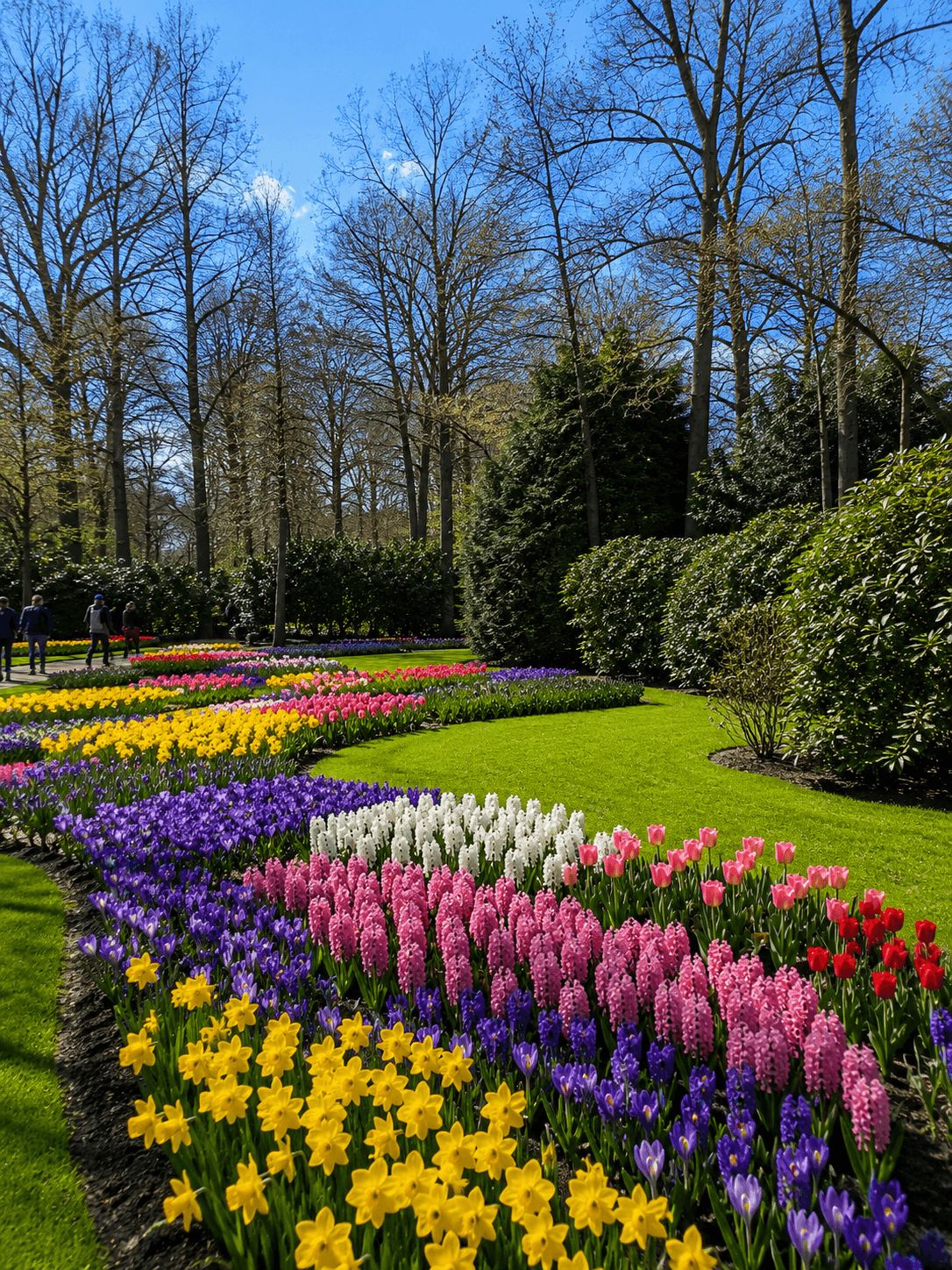
Curved spring flowerbeds inside Keukenhof. The commercial bulb fields lie outside the garden and should only be viewed from public roads and paths.
Buy through the official Keukenhof site and follow its instructions for time slots and parking. The park’s own advice notes that early mornings and late afternoons are often quieter; that is a planning tendency, not a guarantee. Any article or vendor claiming a secret shortcut, a guaranteed empty garden or a precisely forecast peak-bloom date should be treated cautiously.
The seasonal opening window is not a promise that the outdoor tulip fields will bloom at a fixed point within it. Different bulbs flower at different times, and temperature affects when fields outside the park peak. Keukenhof plants for a succession of displays and has indoor exhibits, but a photograph labelled “late April” cannot predict the same colours in a future season. For a photography-led trip, check the official flowering report shortly before departure and retain an alternative plan in case the weather is poor.
Keukenhof’s official visitor information confirms that the 2027 park season runs from 18 March through 9 May 2027, with opening hours listed as 08:00–19:00 and the last admission at 18:15. Use Keukenhof’s own website when choosing the date and arrival slot. The ticket shop, parking products, public-transport combinations and actual flower displays are separate planning questions. Do not use a ticket figure from a previous season or advertise an unconfirmed 2027 price as current.
What Is Confirmed for 2027, and What Still Needs Checking?
Keukenhof 2027: Confirmed Dates and Opening Hours
Keukenhof has published its 2027 season dates and opening hours. Ticket prices and transport products may be published or changed separately, so confirm those on the official website before booking travel.
| Detail | Keukenhof 2027 | Notes |
|---|---|---|
| Opening Date | 18 March 2027 | Early tulips and daffodils already in bloom |
| Closing Date | 9 May 2027 | Late tulips and alliums finishing the season |
| Daily Opening Hours | 08:00 – 19:00 | Entry closes at 18:15; early morning is generally quieter |
| Adult Ticket (online) | Not yet published | Check the official ticket shop before booking |
| Children (3–11 years) | Not yet published | Check current age bands and rates in the official ticket shop |
| Peak Bloom Window | Weather-dependent | Keukenhof plants for colour throughout the season; outdoor fields vary |
| Quietest Period | Last week of March & first days of May | Fewer species in bloom but significantly smaller crowds |
Opening dates and hours are confirmed by Keukenhof. Ticket prices and transport products were not yet published when this guide was checked; confirm them at keukenhof.nl before booking.
The Bulb Region Beyond the Garden
This guide separates the designed displays inside Keukenhof from the working agricultural landscape beyond the park. It covers confirmed 2027 dates, the transport choices that affect your arrival and the limits of predicting outdoor field bloom months in advance.
Behind the flower displays is an agricultural landscape with growers, seasonal labour and carefully managed bulbs. Treat the surrounding fields as working farms: stay on public paths, do not enter the rows and avoid stepping over ditches or fences for a photograph.
Understanding this gives Keukenhof a different weight entirely. When you walk past a bed of 10,000 identical red tulips in perfect synchronised bloom, you are looking at the end result of a year-long agricultural cycle involving hundreds of human hands. That context, in my view, makes the garden significantly more impressive — not less.
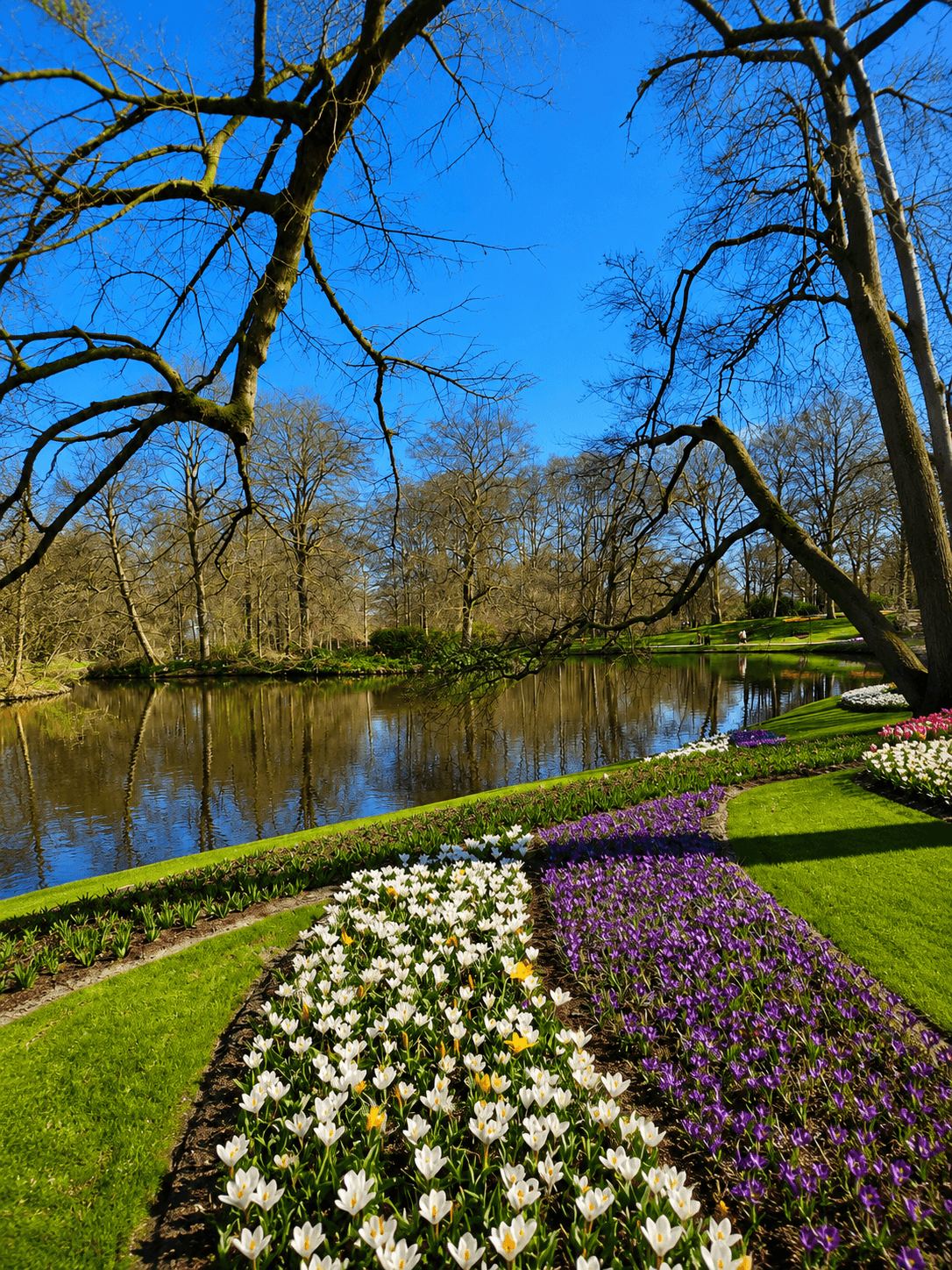
A reflecting pond framed by early crocuses inside Keukenhof; the commercial bulb fields are outside the garden.
The Bloemencorso: The Parade Most Tourists Miss Completely
Here is the single most underrated experience in the entire Keukenhof region, and it is almost entirely overlooked in international travel guides: the Bloemencorso Bollenstreek.
This annual flower parade — one of the largest in the world — runs in late April, usually on the Saturday closest to the final week of Keukenhof’s season. The decorated floats depart from Noordwijk and travel through the heart of the bulb-growing region, passing through Voorhout, Sassenheim, Lisse, Hillegom, and Bennebroek before finishing in Haarlem the following day. The entire route is approximately 42 kilometers.
The floats are not made from plastic or paper. Every single decoration is constructed from real flowers, bulbs, and natural plant material — dahlias, chrysanthemums, gladioli, and of course tulips — attached by hand to enormous steel frames built by local growers, businesses, and community associations. Each float can contain hundreds of thousands of individual flowers. The construction alone takes weeks.
Standing on the pavement in Sassenheim as a child, watching those floats move slowly past with the entire village gathered on both sides of the road, was genuinely magical. It was not a tourist attraction. It was a community celebration of the landscape that fed the entire region.
For international visitors, the Bloemencorso is a different, far more local experience than the garden itself. You can watch from public places along the route, although some grandstands and hospitality packages are paid. If your trip overlaps the parade, check the official route, viewing rules and dates at bloemencorso-bollenstreek.nl.
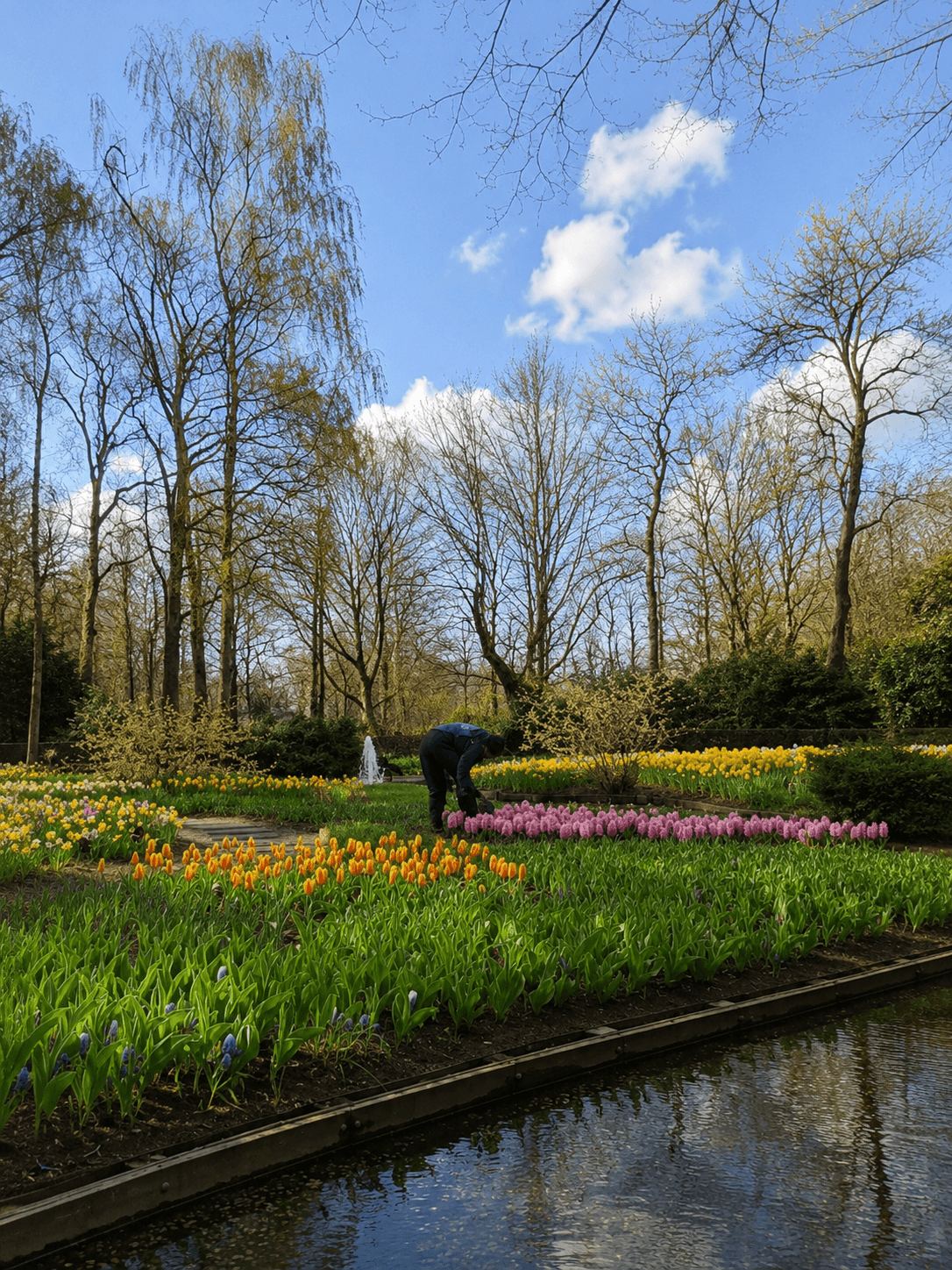
A gardener tends rows of orange and pink tulips inside Keukenhof.
When to Visit Keukenhof 2027: The Honest Crowd and Bloom Guide
A photograph taken in mid-April during a previous season is not a forecast of the same flowering stage in 2027. Flowering depends on weather, cultivar and location. If outdoor field colour is the primary goal, watch the current official flowering updates instead of treating any single weekend as a guaranteed peak.
Here is a more nuanced breakdown of what to expect at different points in the season:
| Period | Crowd Level | What’s in Bloom | Verdict |
|---|---|---|---|
| Late March (opening week) | Low | Early daffodils, muscari, crocuses, early hyacinths | Quiet and beautiful — ideal if you don’t need full tulip bloom |
| First week of April | Medium | Hyacinths at peak, early tulips opening, narcissus fields | Best overall balance of flowers and manageable crowds |
| 8 – 22 April (peak bloom) | Very High | Full tulip peak — virtually every variety in simultaneous bloom | Most colourful time to visit; go on a weekday and arrive by 09:00 AM |
| Late April (Bloemencorso week) | High on weekends | Late tulips, alliums beginning, parrot tulips | Combine with the flower parade for a complete regional experience |
| Early May (closing weeks) | Low–Medium | Late tulips, alliums, late species tulips | Uncrowded with surprisingly interesting late-season varieties |
The Single Best Arrival Strategy
Keukenhof opens at 08:00 during its published 2027 season. The official visitor guidance identifies mornings before 10:30 and afternoons after 16:00 as generally quieter periods, although individual days and school holidays can differ. Choose an entry time that also works with your transport rather than promising yourself an empty park at any fixed hour.
Getting to Keukenhof 2027: Train, Bus, Car and Bike
Keukenhof is located near the town of Lisse in South Holland, roughly 35 kilometers from Amsterdam and 15 kilometers from Leiden. There is no train station at the garden itself, so your final approach always involves a bus, a car, or a bicycle.
| Option | Route | Approx. Cost | Best For |
|---|---|---|---|
| Train + Bus | Amsterdam Centraal → Leiden or Schiphol, then direct Keukenhof Express bus (858 or 857) | €10 – €14 return (covered by OV-chipkaart) | Solo travelers and couples from Amsterdam |
| Car | A4 or A44 motorway to Lisse; follow P+R signs to shuttle parking | Parking approx. €8 + shuttle included | Families and groups of 3 or more |
| Bicycle | Cycle routes from Leiden (±18 km) or Haarlem (±22 km) through the open bulb fields | Free (rental bike approx. €15/day) | The most beautiful and authentic approach — through the actual flower fields |
| Guided Tour | Direct coach from Amsterdam with entry included | €45 – €65 per person | Visitors who want zero logistics — but arrive exactly when the crowds peak |
The bicycle approach deserves special mention. Cycling to Keukenhof through the Bollenstreek — the bulb-growing landscape between Haarlem and Leiden — is the single most rewarding way to arrive, visually. The route takes you through open fields where tulips, daffodils, and hyacinths grow in long, perfectly straight rows of contrasting color. This is the landscape that the garden itself was designed to celebrate. Seeing it from a bicycle at ground level, with the smell of hyacinths thick in the air, is something no organized tour can replicate.
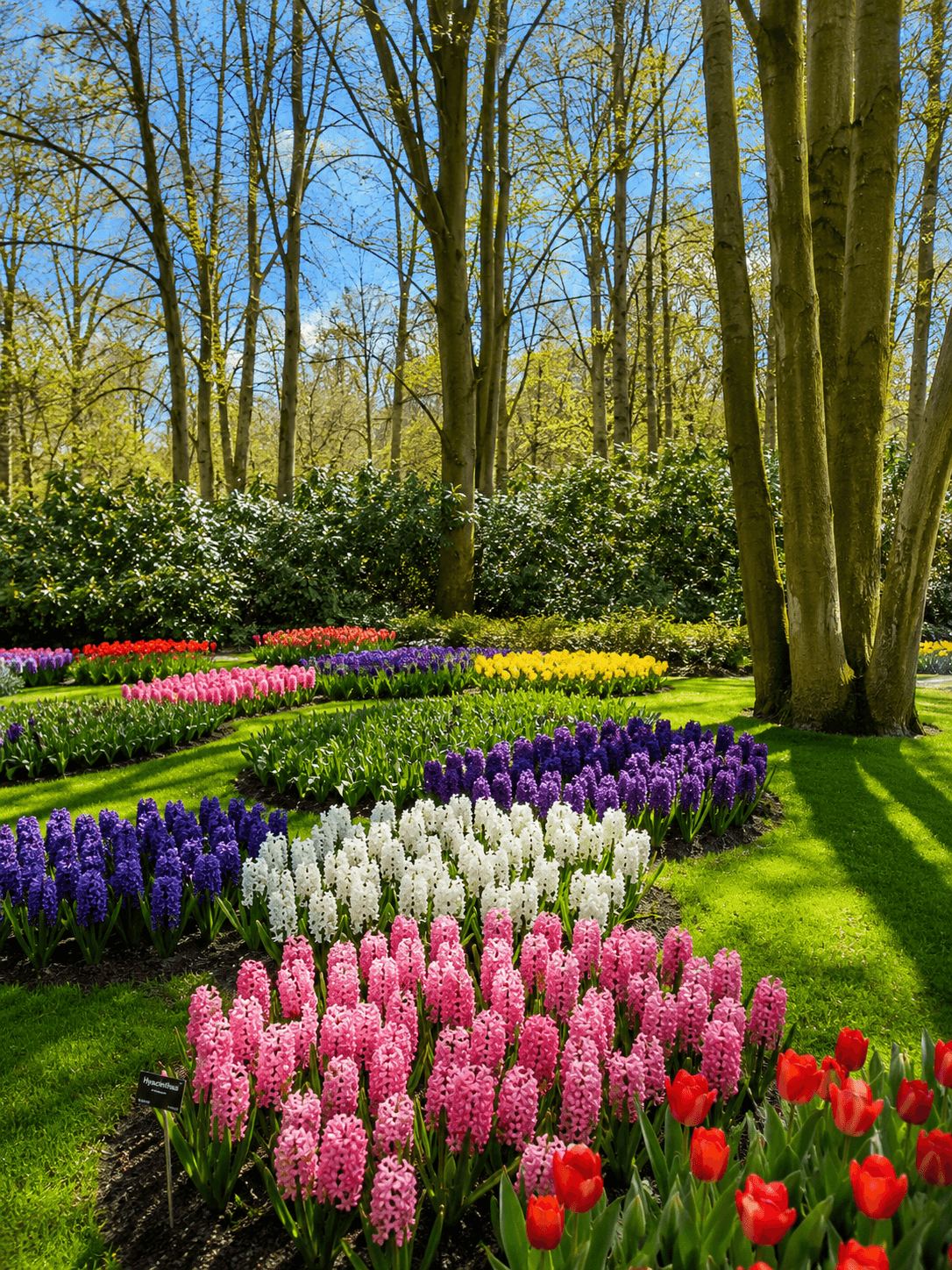
Dense rows of purple, white and pink hyacinths in bloom inside Keukenhof.
Where to See the Tulip Fields Near Keukenhof
This is the section that most travel guides skip entirely — and it is arguably more important than anything inside the garden gates. The tulip fields near Keukenhof are commercial production fields operated by bulb growers across the entire Bollenstreek region. They stretch for kilometers in every direction from the garden estate, and in mid-April they are one of the most visually arresting landscapes in Europe.
Unlike Keukenhof itself, these fields require no ticket, no timed entry, and no advance booking. You cycle past them, stop, and look. The problem is that most visitors arrive by tour bus, go straight into the garden, and never see them at all. Here are the four towns where the tulip fields near Keukenhof are most accessible and most concentrated:
Lisse
The town directly adjacent to Keukenhof estate. The fields between the garden boundary and the town center are the closest accessible bulb fields to the entrance. Cycling south from the main gate toward Lisse takes you through working fields within five minutes. The Keukenhof Bloemenroute — a signposted cycling circuit — departs from Lisse town center and loops through the surrounding production fields for approximately 25 kilometers.
Hillegom
Just north of Lisse, Hillegom sits in the heart of the hyacinth-growing area. The fields around Hillegom tend to peak slightly earlier than the tulip-heavy fields further south — making them ideal for early April visitors who arrive before the main Keukenhof tulip rush. The cycling path along the Vogelenzangseweg corridor between Hillegom and Bennebroek passes through some of the most concentrated flower field density in the region.
Sassenheim
Behind the flower displays is an agricultural landscape with growers, seasonal labour and carefully managed bulbs. Treat the surrounding fields as working farms: stay on public paths, do not enter the rows and avoid stepping over ditches or fences for a photograph.
Voorhout
Further east toward Leiden, the fields around Voorhout are among the least visited by international tourists — which makes them among the most authentic to experience. The cycling route from Leiden Central Station through Warmond and Voorhout toward Keukenhof (approximately 18 kilometers) passes through open tulip fields, narrow dike roads, and traditional Dutch polder landscape with almost no tour group traffic at any point.
The Biggest Mistake First-Time Visitors Make
I see this consistently, and it is the single most common reason people leave Keukenhof feeling vaguely underwhelmed despite having seen millions of flowers: they spend their entire day inside the garden and never step outside the gates.
Keukenhof is a masterpiece of horticultural design. But it is a garden — a contained, manicured, perfectly managed environment. The landscape that surrounds it is something entirely different: raw, agricultural, actively working, and on an entirely different scale. A single tulip field visible through the garden fence contains more flowers than many entire botanical gardens.
The biggest mistake is treating Keukenhof as the destination and the surrounding region as the backdrop. It is the other way around. The Bollenstreek — the bulb-growing landscape of Lisse, Hillegom, Sassenheim, and Voorhout — is the destination. Keukenhof is the most beautiful and accessible window into that landscape. But even a 30-minute bike ride outside the gates, through a single stretch of open production fields, often becomes the most memorable part of the entire day.
The first time I took a visitor out of the Keukenhof gates and onto the cycling path toward Sassenheim, they stopped their bike after about ten minutes, looked out across a field of solid deep-red tulips running to the horizon, and went completely quiet. That silence is what the garden, for all its beauty, cannot quite replicate. Scale does something to a person that curation cannot.
The practical fix is simple: buy your Keukenhof ticket for the morning slot, arrive at 08:00 AM, spend three hours inside the garden, and then exit and rent or retrieve a bicycle for an hour in the surrounding fields before heading back to the train. You will have experienced both halves of what makes this region worth the extra effort.
The garden covers 32 hectares and contains over 800 varieties of tulip alone. On a first visit, it is easy to wander aimlessly and end up seeing less than someone with a clear plan. Here is how to structure your time inside the estate.
The Outer Perimeter Path (Do This First)
The main visitor flow follows the central paved paths near the entrance. Most tourists never walk the outer loop that runs along the estate boundary, adjacent to the open bulb fields. This path is quieter, wider, and — in my view — more beautiful, because it places the garden in direct visual dialogue with the working agricultural landscape surrounding it. The contrast between the manicured garden beds and the raw geometry of the commercial fields beyond the fence is striking.
The Glasshouses
Keukenhof contains several large display glasshouses filled with orchids, lilies, and exotic tulip varieties. The Willem-Alexander Pavilion is the largest and most impressive. On cold or rainy mornings, these are exceptionally comfortable to visit. On peak-crowd days, the queues to enter can be significant — save the glasshouses for mid-morning or early afternoon when the outdoor paths are most congested.
The Open Bulb Field Viewpoint
On the north side of the estate there is an observation platform above one of the garden’s open display fields. This elevated viewpoint gives you a rare aerial perspective on the geometric patterns of mass tulip planting. It is the closest experience to understanding how these fields look from above — and why satellite images of the Bollenstreek in April look like abstract paintings.
What the Garden Does Not Show You: The Reality of the Bulb Fields
This is the part of the Keukenhof story that travel guides consistently omit, and it is the part I find most worth telling.
The flower fields you see through the garden fence — and the even more dramatic ones you cycle through on the approach from Leiden or Haarlem — are commercial production fields. The tulips are not grown for their flowers. They are grown for their bulbs. Which means that in most production fields, the flower heads are deliberately removed — koppensnijden, in Dutch — within a few days of bloom. The reason is agricultural: allowing the flower to fully develop and set seed redirects the plant’s energy away from the bulb itself, reducing the bulb’s quality and size.
The timing of your visit therefore has a narrow window. The flowers you see from the road and from the garden boundary are at their best for roughly ten to fourteen days before the growers send in their machinery to remove the heads. After that, the fields shift from color to green almost overnight.
Working in the bulb fields as a teenager, earning per crate completed, gave me an understanding of this cycle that no tourist brochure ever captured. The beauty you see in April is a byproduct of an industrial agricultural process. That doesn’t diminish it. If anything, knowing that the flowers are incidental — that they are actually there to serve the bulb — makes those two weeks of bloom feel more precious, not less.
Keukenhof for Families: A Practical Guide
Keukenhof is one of the better large-scale tourist sites in the Netherlands for families with younger children. The paths are wide and well-maintained, there are dedicated children’s play areas, and the sheer visual impact of millions of flowers tends to hold even easily distracted children’s attention for longer than most parents expect.
- The Fairy Tale Garden: A dedicated children’s area on the estate featuring sculptural characters from Dutch fairy tales set among the flower beds. Popular with children under 8.
- The Petting Farm: A small farm area with live animals — useful for families who need a non-floral break mid-visit.
- Pushchairs and wheelchairs: The main paths are entirely paved and fully accessible. The outer perimeter paths can be slightly uneven in wet weather.
- Food and drink: There are multiple restaurants and snack points across the estate. Prices are above average — bring your own picnic if you want to eat economically. Picnicking on the garden lawns is permitted.
- Timing with children: A 3-hour visit is comfortable for most families. Arriving at 09:00 AM and leaving before noon avoids both the peak crowd and potential afternoon weather changes.
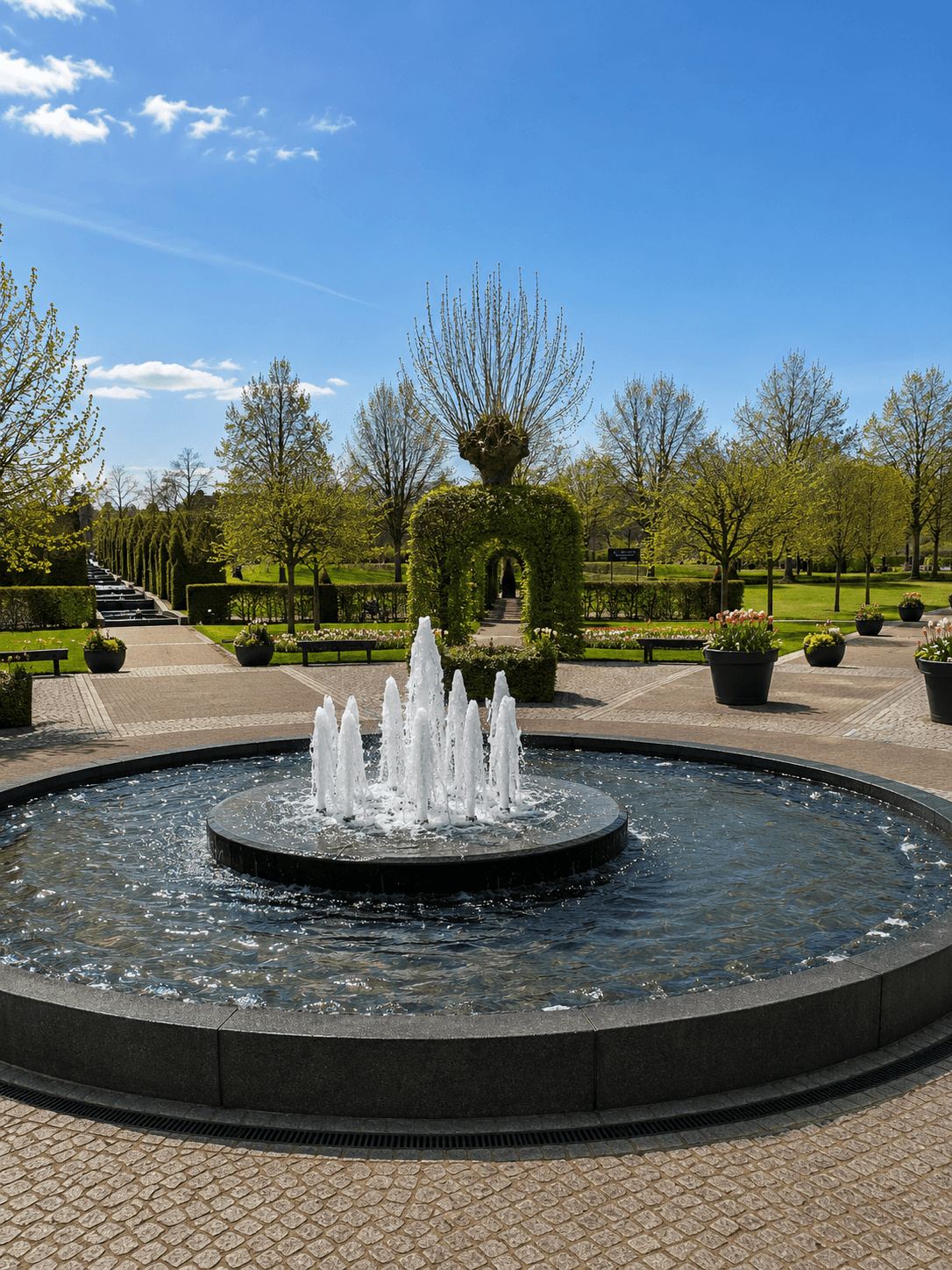
A formal fountain and clipped hedges inside Keukenhof.
A Practical Keukenhof 2027 Visit Plan
08:00 AM — Arrive at the gate. You are among the first visitors of the day. The pathways are empty, the morning light is soft, and the dew is still on the flowers.
08:15 AM — Walk the outer perimeter path first, anti-clockwise from the main entrance. You will have the route almost entirely to yourself and get unobstructed views of the tulip fields beyond the fence.
09:30 AM — Visit the observation platform viewpoint above the open display field. At this hour the light is at its best for photography.
10:15 AM — The first tourist buses begin arriving. Move into the Willem-Alexander Pavilion glasshouse while the outdoor paths start filling up.
11:00 AM — Take a break at one of the garden restaurants for a coffee and a traditional Dutch stroopwafel before walking the central garden beds.
11:30 AM — Walk the central tulip garden beds. By this time most tour groups have passed through the main routes, creating a brief second quiet window before the 12:00 noon peak.
12:30 PM — Exit the garden and either cycle back through the bulb fields toward Leiden, or take the shuttle bus back to the train station. If timing allows, drive or cycle into Lisse for lunch away from the Keukenhof tourist crowd.
🙋 Frequently Asked Questions (FAQ)
When does Keukenhof open in 2027?
Keukenhof 2027 opens on 18 March and closes on 9 May. The published daily hours are 08:00–19:00, with entry closing at 18:15. Recheck keukenhof.nl before making travel bookings.
When is peak bloom at Keukenhof in 2027?
There is no confirmed peak-bloom window for 2027. Keukenhof plans displays across its full season, while the commercial fields outside depend heavily on winter and spring temperatures. Check the official flowering updates close to your visit.
Can you buy Keukenhof tickets at the gate in 2027?
Do not rely on walk-up availability. Keukenhof uses timed entry, and popular slots can sell out. Buy through the official ticket shop in advance and avoid unofficial resellers unless you specifically want a transport or tour package.
What is the best week to visit Keukenhof in 2027?
No week can be guaranteed as the best this far ahead. For lower crowd pressure, choose a Tuesday, Wednesday, or Thursday outside school holidays and arrive near opening time. For bloom conditions, consult the official updates shortly before your visit.
How long do you need at Keukenhof?
Most visitors are satisfied after 2.5 to 3.5 hours. A thorough visit including the glasshouses, the outer perimeter, and the display fields takes approximately 3 to 4 hours. Budget more time if you plan to have lunch on-site or visit with young children at a relaxed pace.
Is Keukenhof worth the ticket price?
Check the official ticket shop for the current adult, child, parking and transport-combination prices, and book an arrival slot through the genuine Keukenhof website. The garden is open for a limited season, so keep enough flexibility in your travel plans to cope with weather and flowering conditions.
What is the Bloemencorso Bollenstreek?
The Bloemencorso Bollenstreek is an annual flower parade running in late April through the heart of the Dutch bulb region, passing through Sassenheim, Lisse, and finishing in Haarlem. The floats are constructed entirely from real flowers and natural materials by local growers and community associations. Unlike Keukenhof, it is completely free to watch from the roadside and represents a deeply local celebration of the agricultural landscape. It is one of the most underrated experiences in the entire region.
Can you cycle through the tulip fields near Keukenhof?
Yes, and you absolutely should. The Bollenstreek has an excellent network of dedicated cycling paths that pass directly through the commercial bulb fields surrounding Lisse, Hillegom, Sassenheim and Voorhout. The best cycling window is the same two weeks as the Keukenhof tulip peak — roughly 8 to 22 April. Bikes can be rented in Leiden, Haarlem, or at Schiphol Airport. The route from Leiden to Keukenhof covers approximately 18 kilometers through the heart of the flower-growing landscape. The signposted Keukenhof Bloemenroute departing from Lisse town center provides a full 25-kilometer loop through the surrounding production fields.
Where are the best tulip fields near Keukenhof?
The most accessible and visually concentrated tulip fields near Keukenhof are found around Lisse (directly adjacent to the garden), Hillegom (hyacinth-heavy, peaks slightly earlier), Sassenheim (along the Warmonderweg toward Voorhout), and Voorhout (quieter, least-visited, ideal for cyclists from Leiden). All four towns are reachable by bicycle from the garden within 15 to 30 minutes.
Final Recommendation: Plan Your Keukenhof 2027 Visit
Keukenhof is one of those Dutch experiences that genuinely lives up to its reputation — but only if you approach it on its own terms. It is not an amusement park, not a festival, and not a photo backdrop. It is an 800-year-old estate in the middle of one of the world’s most important agricultural landscapes, open for eight weeks a year to show the world what those fields produce. Arriving early, moving slowly, and spending ten minutes looking through the fence at the commercial fields beyond the garden boundary will give you a relationship with this place that no brochure can provide.
Plan Your Visit
🌷 Official tickets & dates: keukenhof.nl
🚌 Keukenhof Express bus from Schiphol / Leiden: check connexxion.nl
🚂 Train to Leiden or Schiphol: ns.nl
🎉 Bloemencorso Bollenstreek dates: bloemencorso-bollenstreek.nl
🚲 Cycling routes through the bulb fields: holland.com
🏨 Hotels near Keukenhof (Lisse, Leiden, Haarlem): Booking.com
🗺️ Guided day tours from Amsterdam: Viator or GetYourGuide
Sources: keukenhof.nl (official 2027 dates and hours) | bloemencorso-bollenstreek.nl | Personal observation — Bollenstreek region, Sassenheim | ns.nl (train timetables)